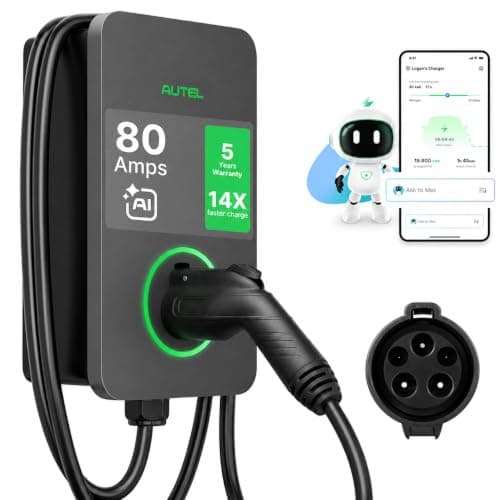
The Autel MaxiCharger AC Pro is the J1772 way to get the full 19.2 kW at home, and on its own terms it is very good: 80 amps hardwired, Wi-Fi and app control, OCPP for advanced setups, an indoor/outdoor rating, a long warranty and a 25-foot cable. Buy it if your car's onboard charger accepts 19.2 kW andyour panel can carry a dedicated 100-amp circuit. If either of those is false — and for most readers both are — this charger delivers exactly the same charging speed as a 48-amp unit at roughly half the price, plus a much larger electrical bill. That is the whole review in one paragraph, and we would rather you read it than discover it after the install.
Who this charger is for
There is a real buyer here, and it is worth naming precisely because the listings never do. You want the MaxiCharger AC Pro if:
- Your car has a 19.2 kW onboard charger and a J1772 inlet. This is the whole case for the product. Most EVs cap AC charging at 11.5 kW (48 amps) and a good many are lower — a Mach-E is 48 amps, an Ioniq 5 lower still, and a retail F-150 Lightning is 48 amps with the 19.2 kW unit reserved for fleet configurations. Check the window sticker or the owner's manual before anything else.
- Your panel can spare a hardwired 100-amp circuit. Under NEC 625.42's 125% continuous-load rule, 80 amps of charging needs a 100-amp breaker and conductors sized for it. On a 200-amp service that is a serious load calculation; on a 100-amp service it is impossible without a service upgrade.
- You want app control and cloud features, not just a cable. Wi-Fi, Bluetooth, scheduling, energy reporting, and OCPP support for anyone running more than one unit or billing usage.
If you are nodding at the first point, this is a straightforward recommendation. If you had to guess, go and look — the guess is wrong far more often than not.
What you actually get
Autel publishes the figures that matter on the listing: up to 80 amps / 19.2 kW, a J1772 connector, hardwired installation on a 100-amp circuit, Wi-Fi and app control, and a 25-foot cable. At the full rate that is in the region of 70 miles of range added per hour for a car that can take it — a genuinely different experience from a 40-amp charger, if and only if the car cooperates.
The 25-foot cable deserves a mention, because 80-amp cable is thick and heavy and plenty of premium chargers ship shorter. Twenty-five feet means you can reach a port on the far side of a vehicle without an extension, and the indoor/outdoor rating means the unit does not have to live in the garage. Pair it with a cable organizer— at this gauge, a cable left on the floor is both a trip hazard and a slow way to damage an expensive cordset.
What we would want you to know before buying
The install is the real cost. A 100-amp dedicated circuit means heavy conductors, likely a sub-panel conversation, a permit in nearly every jurisdiction, and in many homes a service upgrade first. Our installation cost guide and wire size and breaker guide set out what that involves. It is normal for the electrical work on an 80-amp install to exceed the price of the charger.
It leans on Wi-Fi and the cloud. That is where the app features come from, and it is also a dependency. If your garage Wi-Fi is marginal, read EV charger Wi-Fi connection problems before you commit, and consider whether a charger without an app suits you better.
It costs roughly double a good 48-amp charger. Which is the right price for what it does, and the wrong price for what most cars can use. The honest comparison is not Autel against Autel; it is this charger against a 48-amp unit plus the money and electrical work you did not spend.
The two-minute check that saves the most money on this page. Find your car's onboard chargerrating — owner's manual, window sticker, or the manufacturer's specification sheet. If it says 11.5 kW, 11 kW, 10.9 kW, 10.5 kW or 7.7 kW, an 80-amp charger will not charge your car one minute faster than a 48-amp one. Our what amp EV charger do I need guide explains how the car sets the ceiling, and charging speed: kW vs amps covers the arithmetic.
How it compares
Its direct rival is the Grizzl-E Ultimate, the other 80-amp charger with a current listing — and the comparison resolves on the connector rather than the specification, because the Ultimate we can buy is the NACS version. J1772 car, Autel; NACS car, Grizzl-E. We put the two brands side by side in Grizzl-E vs Autel.
Against Autel's own 40-amp MaxiCharger, the AC Pro is the same software and app experience with four times the install. If you like the Autel ecosystem and your car caps at 48 amps, the 40-amp MaxiCharger review is the page you want, and Autel MaxiCharger vs Emporia puts it against the value benchmark.
Against the 48-amp field — which is where most readers should actually be shopping — see best 48-amp EV chargers. For the narrow question of whether 80 amps is for you at all, the 80-amp roundup is the page that answers it.
How we assessed it
We do not have a test lab and this review is not a bench test. What it is: the manufacturer's published specifications from the live listing, read against the electrical requirements the NEC actually imposes and against the onboard-charger ratings the vehicle manufacturers publish. That combination is what tells you whether a charger will do anything for you, and it is where almost every 80-amp purchase goes wrong.
Charge speed — the highest score here, with a caveat attached. Eighty amps and 19.2 kW is the top of residential AC charging. The score reflects the hardware's capability, not the speed your car will see, which is capped by its onboard charger.
Build and weather. Indoor/outdoor rated with a long warranty. Solid, without matching the metal-box construction Grizzl-E leads on.
Smart features. Among the strongest in the category: Wi-Fi, Bluetooth, app scheduling, energy reporting and OCPP. If you want a charger that behaves like a connected device, this is the brand that does it most thoroughly.
Cable and connector. Twenty-five feet of 80-amp-rated cable with a J1772 connector — long for the tier, and the right connector for most non-Tesla EVs.
Value. The score we hold back. The hardware justifies the price; the number of households that can convert the price into actual charging speed is small. That is a mismatch between product and buyer, not a flaw in the product.
Before you buy, in order
1. Confirm your car's onboard charger rating. 2. Have an electrician run the load calculation on your panel for a 100-amp circuit. 3. Only then compare prices. Doing those in the other order is how people end up with an 80-amp charger feeding a 48-amp car. If step one or two fails, the home charger roundup is where to go instead, and if the panel is the obstacle rather than the car, read the load-managed charger roundup.