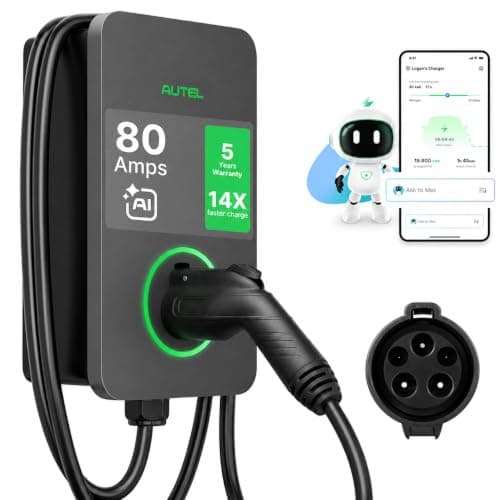
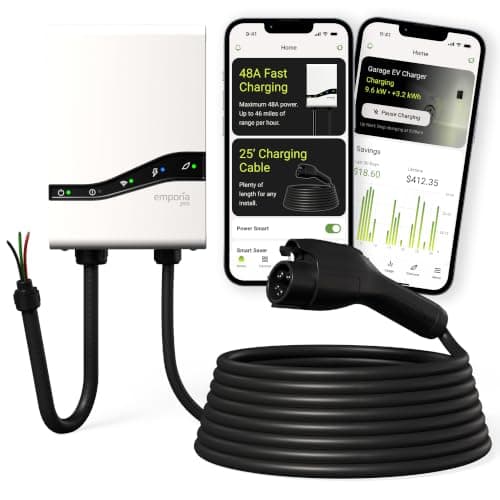
For a retail Ford F-150 Lightning the charger to buy is a 48-amp hardwired unit, and the one we rank first is the Emporia Pro in its J1772 form — the full 48 amps, a NEMA 4 enclosure for a truck that often charges on an outside wall, and panel-wide load management in the carton, which matters more on this vehicle than on any other because a 131 kWh battery is the largest sustained household load most homes will ever add. If you would rather plug in than hardwire, the ChargePoint Home Flex is adjustable up to 50 amps on a NEMA 14-50 receptacle. The 80-amp Autel MaxiCharger AC Pro is on this page for exactly one reader: somebody with a fleet-configured truck.
This is the page where the popular advice is simply wrong, and it is worth being precise about why. A great many home-charging guides state that the Lightning has a dual onboard charger good for 19.2 kW and that you therefore want an 80-amp charger. Ford's own 2025 F-150 Lightning technical specification sheet lists the onboard charger as 11.3 kW input / 10.5 kW output (48A) across the 98 kWh, 123 kWh and 131 kWh batteries, and lists the 19.2 / 17.6 kW unit as a fleet option with a footnote that it is fleet configuration only and not available for retail sale. Ford's charging FAQ says the same thing in plainer words: the 2024 and 2025 Standard and Extended Range trucks charge at 48 amps.
So unless you bought your truck through a commercial fleet order, an 80-amp charger and the hardwired 100-amp circuit it requires will deliver you exactly the same 48 amps a charger costing half as much delivers. That is the single most expensive mistake available on this page, and it is the one the search results push you toward.
The short version
- Emporia Pro (48A, PowerSmart) — best overall for a Lightning. The full 48 amps hardwired, NEMA 4, UL listed and ENERGY STAR certified, with the Vue energy monitor and mains current sensors included so PowerSmart can hold the whole house inside your service limit instead of tripping the main.
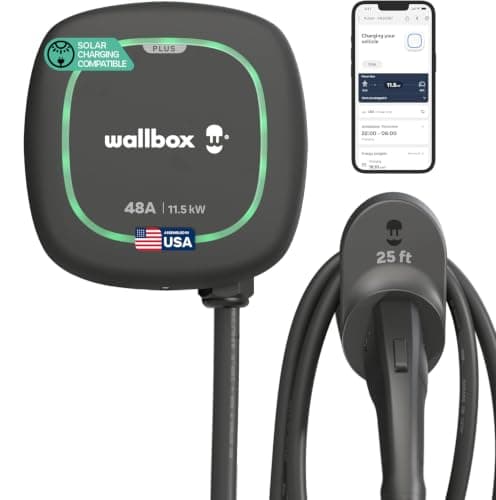
- Wallbox Pulsar Plus (48A) — best compact 48-amp unit. The other route to the full rate the truck's circuit will carry, in the smallest enclosure in this group, with a 25-foot cable. Full review.
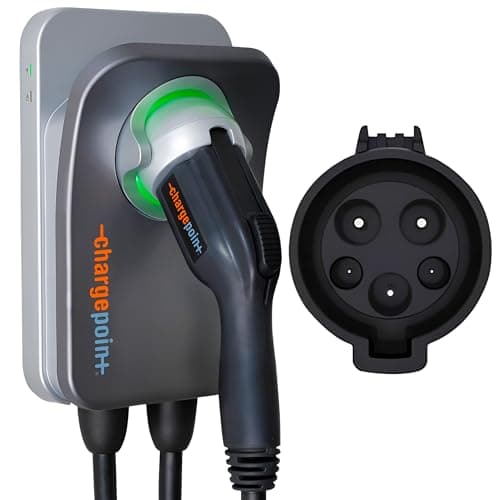
- ChargePoint Home Flex — best plug-in choice. Adjustable in the app up to 50 amps, so it fits whatever breaker your electrician lands, and the same account covers public ChargePoint stations when you are towing. Full review.
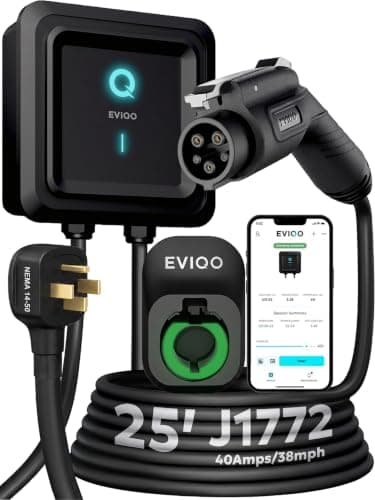
- EVIQO Level 2 (40A) — best value. UL and ETL listed, IP66 / NEMA 4, a 25-foot cable, 9.6 kW. Slower than the truck can take, and still a full battery across a long night. Full review.
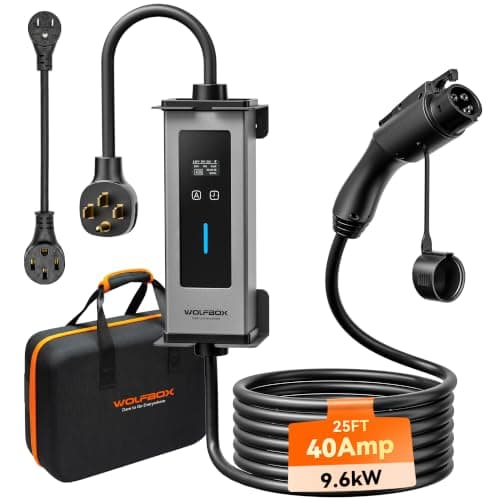
- WOLFBOX Portable (6–40A) — best one to keep in the frunk. A dual-voltage cord with both a 14-50 and a household 5-15 plug, adjustable down to 6 amps, which is what you want at a jobsite or a campground pedestal. Full review.
- Autel MaxiCharger AC Pro (80A) — only for a fleet-configured truck. The J1772 way to a genuine 19.2 kW, on a hardwired 100-amp circuit. Correct for the fleet 19.2 kW onboard charger, pointless for every retail Lightning. Full review.
What a retail Lightning actually accepts
- 11.3 kW in, 10.5 kW out, 48 amps. Ford's specification sheet gives both numbers; the difference is conversion loss inside the onboard charger. The practical figure is 48 amps, which means a 48-amp charger on a 60-amp circuit is the ceiling and a 40-amp charger gets you about 83% of it.
- 98, 123 or 131 kWh of battery. This is the real story of the truck. Even at the full 48 amps, Ford's own sheet puts 15% to 100% at roughly 10 hours for the 98 kWh pack, 12 hours for 123 kWh and 13 hours for 131 kWh. An F-150 Lightning is the one vehicle where a 40-amp charger can genuinely run out of night if you arrive home nearly empty.
- A CCS1 inlet — J1772 for AC. The Chargeport's connector tracker lists the F-150 Lightning as CCS1 through the 2025 model year, with a paid adapter for Tesla Superchargers. So every charger on this page connects natively, and the Supercharger question is a DC adapter purchase rather than a different home charger.
Pro Power Onboard changes the install conversation, not the charger. The Lightning's generator feature, and the home-backup hardware some owners add, are a separate electrical project from the charger circuit and they compete for the same panel space. If your panel is already tight, read the load-managed charger roundup and the 100-amp panel roundup before you choose amperage at all. Load management is frequently the difference between a charger install and a service upgrade.
Why cable length matters more on this truck than on anything else
An F-150 Lightning is a little over 19 feet long and its charge port sits on the driver's-side front fender. Park nose-in with the charger on the back wall and a 16-foot cable will not reach the front of the truck. This is not a theoretical problem; it is the most common regret we see from owners who bought on price alone. The Emporia, Wallbox, EVIQO and WOLFBOX picks all publish 25-foot cables for exactly this reason.
Measure the real route, not the straight line: up the wall, along to the parking position, down to the port, with slack so the cable is not under tension. Our cable length guide walks through it, EV charger mounting height covers where to put the unit, and if nothing on the market reaches, the extension cable roundup is the honest fallback.
How the picks compare on paper
Published manufacturer figures from the live listings, with the live price alongside. For a retail truck, read the first column and stop at 48 amps.
| Charger | Best for | Published specs (manufacturer) | Price |
|---|
| Emporia Pro (48A, PowerSmart) | A 100-amp service you would rather not upgrade | Up to 48A hardwired · J1772 · PowerSmart + Vue monitor · UL · ENERGY STAR · NEMA 4 | $599.00 |
| Wallbox Pulsar Plus (48A) | A compact, fast, hardwired install | Hardwired 48A / 11.5kW · J1772 · 25ft cable · Energy Star + UL | $699.00 |
| ChargePoint Home Flex | Buyers who want the established brand and app | Adjustable to 50A · J1772 · NEMA 14-50 plug · Energy Star | $599.00 |
| EVIQO Level 2 (40A) | Budget-conscious buyers who still want smart features | 40A / 9.6kW · J1772 · 25ft cable · UL & ETL, IP66/NEMA 4 | $449.99 |
| WOLFBOX Portable (Level 1/2) | One charger for home and travel | 6–40A · 9.6kW · J1772 · Level 1/2 · NEMA 14-50 + 5-15 · ETL · IP66 · 25ft | $299.99 |
| Autel MaxiCharger 80A (AC Pro) | J1772 cars with a 19.2 kW onboard charger | Up to 80A / 19.2 kW · J1772 · Hardwired · 100A circuit · Wi-Fi + app, 25ft | $908.65 |
#ad Prices read live from the Amazon Product API as of October 17, 2026, and they move. Specs are the manufacturer's published claims from the live listing — we have not bench-measured them. Where we have no verified price we print none rather than a number that has gone stale.
What we left out, and why
The Ford Charge Station Pro itself. Ford's own 80-amp unit is the hardware the fleet 19.2 kW configuration pairs with, and it is also the piece that enables home backup power on trucks equipped for it. We do not rank it here because it is not a current Amazon listing we can price and link honestly — and because on a retail truck it does not charge faster than the 48-amp picks above. If home backup is your reason for wanting it, that is a Ford dealer and licensed-electrician conversation, not a shopping decision.
NACS wall chargers. The Lightning charges on AC through a J1772 inlet through at least the 2025 model year, so a NACS charger would need an adapter permanently in the loop. The NACS home charger roundup is for cars with a native NACS port.
Level 1 only. A household outlet adds roughly 3 to 4 miles of range an hour. Against 131 kWh that is close to a week from low. There is no version of a Lightning where Level 1 is the plan — see can you live with only Level 1 charging for the cars where that case does hold.
How we ranked these for the Lightning specifically
Does it deliver 48 amps? On a truck with a 131 kWh battery the full 48 amps is worth more than it is on a small EV, because the charging window is genuinely long. The Emporia Pro and Wallbox Pulsar Plus deliver 48 amps; the ChargePoint Home Flex is adjustable up to 50 and reaches it if the circuit is there. The 40-amp picks are the value play, and on this vehicle that trade costs you real hours rather than theoretical ones.
Does the panel survive it? A 48-amp charger is 60 amps of continuous load under NEC 625.42's 125% rule. Added to an older 100-amp service, that frequently fails the load calculation outright. The Emporia Pro leads this list partly for that reason: it ships with the Vue monitor and mains CT sensors, and under the 2023 NEC a load calculation may count an energy management system's capped setpoint rather than the charger's nameplate. Our CT clamp explainer covers how that measurement actually works.
Weather rating, because trucks often charge outside. A Lightning does not always fit in the garage it is parked next to. The Emporia Pro, Wallbox and EVIQO picks publish NEMA 4 or IP66 enclosures; the ChargePoint publishes Type 3R. If the unit will see driven rain or snow, that difference is the spec to read — we rank by published weather figures in the outdoor roundup and by low-temperature limits in the cold-weather roundup.
Cable reach, measured rather than guessed. Nineteen feet of truck with the port at the front corner. Twenty-five feet of cable is the sensible default, and anything under 20 feet needs you to have measured first.
A named safety listing. UL or ETL on the unit, stated by the manufacturer. Every pick here has one. At 48 amps of continuous current in an attached garage this is not the line item to economize on.
Scheduling, for time-of-use rates. Charging a 131 kWh battery on peak rates is the most expensive habit available to an EV owner. Every smart pick here schedules in-app, the truck schedules from its own screen, and how to save money charging an EV runs the arithmetic on what that is worth.