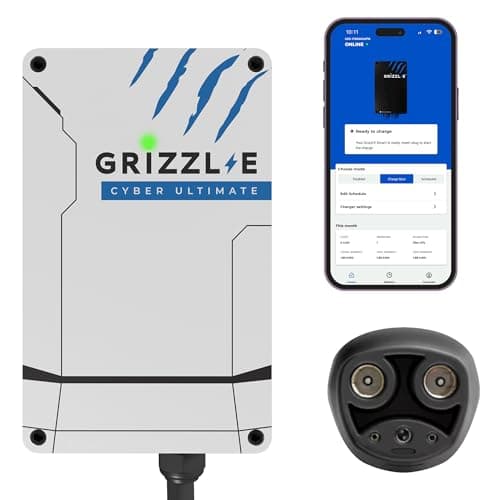
The Grizzl-E Ultimate is the toughest charger we rank and the only 80-amp unit with a native NACS plug and a current listing. Buy it if you have a Tesla or other NACS-port car whose onboard charger accepts 19.2 kW, a panel that can carry a hardwired 100-amp circuit, and a wall that sees real weather — the UL Type 4 metal enclosure and the stated ability to schedule without an internet connection are exactly what you want in that situation. If your car caps at 11.5 kW, which most do, then a 48-amp NACS charger charges it at the same speed for a fraction of the hardware and electrical cost, and that is the purchase we would push you toward.
What Grizzl-E is actually selling
Grizzl-E's proposition has never been features; it is construction. The Ultimate is the fastest version of that idea: Grizzl-E publishes a heavy-duty UL Type 4 indoor/outdoor metal enclosure, made in Canada, carrying up to 80 amps / 19.2 kW through a native NACS (Tesla-style) connector, hardwired on a 100-amp circuit. The other thing worth paying for is quieter and matters more day to day: Grizzl-E states that scheduling and energy statistics work with or without an internet connection.
That last point is the difference between a charger and an appliance that depends on your router. Plenty of smart chargers lose their schedule when the cloud is unreachable, which on a time-of-use tariff means charging at peak rates without being told. We see enough of that failure mode to have written a page about it — EV charger Wi-Fi connection problems — and a charger that holds its own schedule is the structural fix.
Who this charger is for
- A NACS-port car that accepts 19.2 kW on AC. This is the condition that justifies the whole purchase. Most EVs cap AC charging at 11.5 kW (48 amps), and the cars that exceed it are a short list. Find your car's onboard charger rating in the manual or on the window sticker before you shop at this tier.
- A panel that can spare a hardwired 100-amp circuit. NEC 625.42 treats EV charging as a continuous load and requires 125% of the charger's output, so 80 amps needs a 100-amp breaker and conductors to match. On an older service this is a service-upgrade conversation before it is a charger conversation — see our wire size and breaker guide.
- An outdoor wall, or a hard climate. UL Type 4 is the most protective enclosure rating in our rankings. If the charger is going on the outside of the house where it sees driven rain and winter, this is the conservative choice — we rank published weather figures across the field in the outdoor roundup and the cold-weather roundup.
- A household that would rather not depend on an app. You get scheduling and stats either way, with or without a connection. If you want to skip apps entirely, our best dumb EV chargers page is the cheaper expression of the same preference.
What we would want you to know before buying
The install is the real cost, again. A hardwired 100-amp circuit means heavy conductors, a permit in nearly every jurisdiction, and in a lot of houses a service upgrade. It is normal for the electrical work on an 80-amp install to cost more than the charger. Our installation cost guide has the ranges, and do I need a permit for an EV charger covers the paperwork.
Stock is the recurring frustration with this product line. The J1772 versions of the Ultimate were unavailable when we last resolved listings, and stock on the NACS unit runs thin. That is why the NACS version is the Ultimate we feature, and it is worth knowing before you set your heart on a particular variant.
It is a NACS charger, so a J1772 car needs an adapter. That works — a UL-listed adapter carries full Level 2 current and does not slow charging at these rates — but it is one more part living permanently on the end of the cable. If your car is J1772 and you are buying new, the Autel MaxiCharger AC Pro is the native 80-amp answer. We rank the adapters in the best NACS to J1772 adapters.
Smart features are adequate, not class-leading. If you want granular app control, OCPP, energy dashboards and integrations, Autel and ChargePoint are further ahead. Grizzl-E spends its budget on the box.
The check that decides this purchase. Look up your car's onboard chargerrating — not its DC fast-charging figure, which is a different number entirely. If it reads 11.5 kW or lower, an 80-amp charger will not add a single minute of charging speed over a 48-amp one. Our charging speed: kW vs amps explainer covers why, and the NACS home charger roundup is where to shop if the answer is 48 amps.
How it compares
Its only direct rival is the Autel MaxiCharger AC Pro, and the two do not really compete on specification — they compete on which plug your car has. Autel is J1772 with stronger app features; Grizzl-E is NACS with a tougher enclosure and offline scheduling. We put the brands side by side in Grizzl-E vs Autel.
Within Grizzl-E's own range, the Duo Connect is the unit to look at if you have two cars and one circuit, and the Classic— the sealed, no-app charger that built the brand's reputation — no longer has a live Amazon listing, which is why we keep that page as a reference rather than a recommendation. For the broader comparisons, see Grizzl-E vs Emporia and EVIQO vs Grizzl-E.
How we assessed it
We do not have a test lab and this is not a bench test. It is the manufacturer's published specifications from the live listing, read against the electrical requirements the NEC imposes and against the onboard-charger ratings vehicle makers publish — which together determine whether a charger will do anything for you.
Charge speed. Eighty amps and 19.2 kW is the top of residential AC charging. The score reflects the hardware, not the speed your particular car will see.
Build and weather — the highest mark we give. A heavy-duty UL Type 4 indoor/outdoor metal enclosure, manufactured in Canada. Nothing else we rank is built like this, and it is the reason to choose Grizzl-E over anything else on an exposed wall.
Smart features. Scheduling and energy statistics that work online or off. Fewer features than the app-first brands, with a meaningful reliability advantage: the schedule does not depend on a cloud service being reachable.
Cable and connector. A native NACS plug, which is the right connector for a Tesla or a 2025-or-newer NACS-port EV and the wrong one for a J1772 car without an adapter.
Value. The mark we hold back, for the same reason as every 80-amp charger: the price is defensible for the hardware and hard to convert into charging speed for most cars. Buy it for the enclosure and the offline operation as much as for the amperage, because for many buyers the amperage is the part they will never use.
Before you buy, in order
1. Confirm your car has a native NACS port, or accept an adapter. 2. Confirm its onboard charger rating — if it is 11.5 kW or lower, shop the 48-amp field instead. 3. Have an electrician run the load calculation for a hardwired 100-amp circuit. 4. Only then compare prices. If step two or three fails, the NACS home charger roundup is the page you want, and if the panel is the obstacle, the load-managed roundup covers the chargers that work around it.