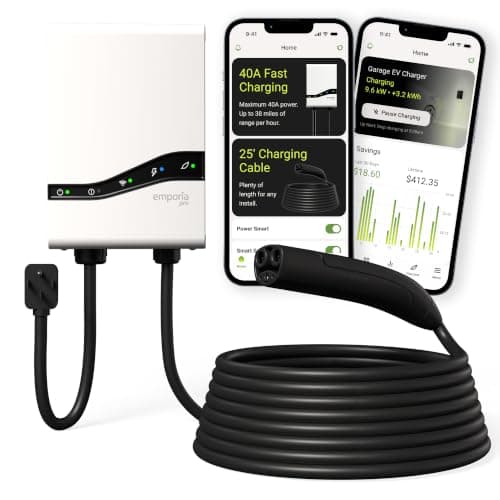
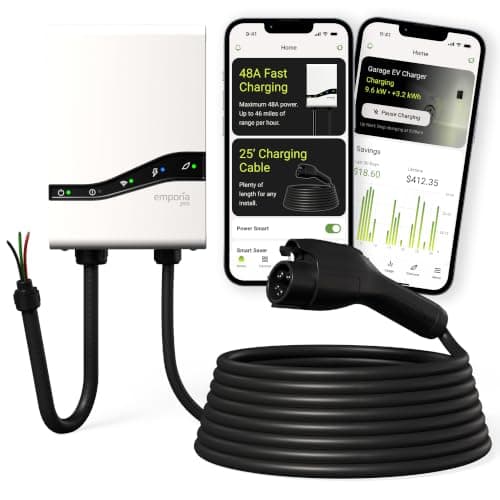
The Emporia Pro is the charger to buy when your electrical panel, not your budget, is the obstacle. Everything else at this price gives you 48 amps; the Pro gives you 48 amps plus a way to keep the whole house inside its service limit, because it ships with the Vue 3 energy monitor and two 200-amp mains current sensors and its PowerSmart logic throttles the charger when the rest of the house is drawing hard. Buy the J1772 versionif your car has the standard inlet — a Ford, GM, Hyundai through 2024, Kia, VW, BMW — and the NACS version if it has a Tesla-style port. They are the same charger. If your panel already has room for the circuit you want, skip the Pro entirely and buy the standard Emporia Level 2: it charges at exactly the same rate for meaningfully less.
What PowerSmart actually does
Load management is the most misunderstood feature in home charging, so it is worth being concrete. A normal 48-amp charger is a fixed 60-amp continuous load on your panel: under NEC 625.42's 125% rule the circuit must be rated at 125% of the charger's output, and the load calculation has to find room for all of it. On an older 100-amp service, it frequently cannot, and the answer you get from an electrician is "service upgrade first."
PowerSmart changes the input to that calculation. Emporia bundles the Vue 3 monitor and two mains CT sensors, which clamp around the service conductors inside your panel and measure what the entire house is pulling in real time. When the dryer, the oven and the air conditioner all run at once, the charger backs off; when they stop, it ramps back up. Under the 2023 NEC a load calculation may count an energy management system's capped setpoint rather than the charger's nameplate — which is the mechanism by which a Pro can turn "you need a service upgrade" into "you need a setting." Our CT clamp explainer covers how the measurement works, and the load-managed charger roundup ranks the whole category.
Two caveats, stated plainly. First, the Vue monitor has to go insideyour electrical panel, so this is licensed-electrician work — there is no version of this you install yourself in an afternoon. Second, whether load management is accepted in place of a service upgrade is your local inspector's call, not the manufacturer's. Ask before you buy, not after.
Which variant should you buy?
Emporia sells the Pro in two forms that differ only in the connector on the end of the cable, and this is the single easiest way to get this purchase wrong.
- Emporia Pro (J1772). The standard connector used by most non-Tesla EVs: Ford, GM, Hyundai and Kia through the 2024 model year, VW, BMW, Nissan, Volvo, Subaru, Toyota. If you are not sure, look at the inlet on your car — a round five-pin plug with two big DC pins beneath it is J1772/CCS1.
- Emporia Pro NACS. The Tesla-style J3400 plug, for a Tesla or for a car that shipped with a native NACS port — which now includes the 2025-and-newer Hyundai Ioniq 5. We review it separately in the Emporia Pro NACS review.
Mismatched is not fatal — an adapter bridges either direction and does not reduce Level 2 charging speed — but it is an avoidable part hanging off your cable forever. If you genuinely have one car of each kind in the driveway, read the best chargers for two EVs instead, and NACS vs J1772 if the standards themselves are the confusing part.
What you get, beyond the load management
Emporia publishes the figures on the listing: up to 48 amps hardwiredon a 60-amp circuit — about 11.5 kW, so no speed is traded away for the panel features — a 25-foot cable, a NEMA 4 enclosure, UL listed and ENERGY STAR certified. The plug-in variant of the hardware runs up to 40 amps on a NEMA 14-50 receptacle instead.
That is a strong specification even setting PowerSmart aside: NEMA 4 is a real outdoor rating, 48 amps is the practical ceiling for almost every EV on sale, and 25 feet of cable covers most garage geometry. Pair it with a cable organizer and a holster and the install looks finished rather than improvised.
The question that decides whether to buy the Pro at all. Ask an electrician to run the load calculation on your panel for the circuit you want. If it passes, buy a standard 48-amp charger and spend the difference on the install — PowerSmart solves a problem you do not have. If it fails, the Pro is one of the few products that can change the answer, and it is cheaper than a service upgrade by a wide margin. Our 100-amp panel roundup is the page for that situation, and the installation cost guide has the figures to compare against.
How it compares
Against Emporia's own range: the standard Emporia Level 2 is the same 48 amps without PowerSmart or the bundled monitor, and it is the better buy whenever the panel is not the constraint. We set the two side by side in Emporia Pro NACS vs Emporia NACS.
Against the rest of the field: the ChargePoint Home Flex is the mature-brand alternative with the stronger public-charging story but no bundled panel monitoring; the Wallbox Pulsar Plus is the compact 48-amp hardwired rival; and the EVIQO Level 2 is the value pick that wins on price per amp. For the whole field, see best home EV chargers and best 48-amp EV chargers.
One more comparison worth making, because it is the cheap alternative people reach for: a dryer-circuit splitter switch also avoids panel work, at 24 amps instead of 48 and with no permit at all. Different product, same underlying problem — and on a small battery it is the more sensible spend.
How we assessed it
We do not have a test lab and this is not a bench test. It is Emporia's published specifications from the live listing, read against the electrical rules that decide whether a 48-amp charger can go on your wall at all.
Charge speed. The full 48 amps, about 11.5 kW, hardwired on a 60-amp circuit. Nothing is traded away for the load management, which is the point: this is not a slow charger that plays nicely, it is a fast charger that knows when to back off.
Smart features — the highest mark we give in the category. Whole- panel awareness through the bundled Vue 3 monitor and two 200-amp mains CT sensors, plus app scheduling and energy reporting. Most "smart" chargers know about themselves; this one knows about the house.
Build and weather. NEMA 4 enclosure, UL listed, ENERGY STAR certified. A genuine outdoor rating, short of Grizzl-E's metal UL Type 4 box.
Cable and connector. Twenty-five feet, in your choice of J1772 or NACS — the choice being the thing to get right at purchase.
Value. The mark we hold back, and deliberately. This is the most expensive charger in its group, and the premium buys panel headroom rather than charging speed. If you need the headroom it is excellent value against a service upgrade. If you do not, it is the wrong purchase at any price.
Before you buy, in order
1. Check your car's connector and pick the matching variant. 2. Have an electrician run the load calculation for the circuit you want — if it passes, buy a cheaper 48-amp charger. 3. If it fails, ask your inspector whether a load-managed install is acceptable in your jurisdiction. 4. Then buy. Doing step three last is how people end up with a feature their AHJ will not count. Our permit guide covers who to ask, and do I need a dedicated circuit covers the baseline requirement either way.