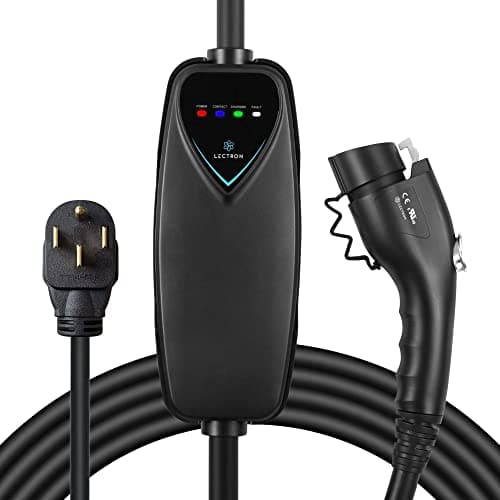
Buy this charger if you have a working NEMA 14-50 outlet, a J1772 car, and no interest in an app. It is the cheapest Level 2 unit on this site from a brand that has been in EV charging for years rather than a marketplace name that appeared last quarter, it carries a real ETL listing, and at 40 amps it refills a normal day's driving in about an hour. Do not buy it if your charge port is more than about fourteen feet from the outlet — the cable is 16 feet and that is the specification people regret — or if you want scheduling and energy monitoring, where the Emporia is a better purchase for not much more money.
What Lectron is actually selling
Lectron's own product page gives the figures plainly: up to 40 amps at up to 240 volts for up to 9.6 kW, a NEMA 14-50 plug on the supply side, a J1772 connector on the car side, and a 16-foot cable. It ships with a carrying case, which tells you how Lectron thinks about this product: the listing describes it as a portable Level 2 charger rather than a wall box, and the case is there so it can live in the trunk between uses.
That framing matters more than it sounds. A 14-50 plug and a carrying case make this a charger you can take to a rental, a relative's house or a campsite pedestal, which is a genuinely different proposition from a hardwired wall unit. It also explains the short cable — 16 feet is awkward on a garage wall and perfectly sensible coiled in a case. If travel is the point, read the portable charger roundup alongside this review, because several units there adjust their current down to 8 or 16 amps for weak circuits and this one does not.
The certification wording, spelled out
This is the part of the review that took the longest, and it is the reason we rank the charger where we do rather than higher or lower. Three different claims appear across the places Lectron sells this unit:
- The Amazon listing titlesays “ETL Certified” and names no standard number.
- Lectron's own specification listsays “UL2594 / UL2231 Certified”.
- The description on that same pagesays the charger handle is “UL 2251 certified”, which is the connector standard rather than the equipment standard.
Read charitably and consistently, the defensible version is this: the unit is ETL listed, tested to the UL 2594 standardfor electric vehicle supply equipment, with UL 2231 covering personnel-protection devices and UL 2251 covering the coupler. A third-party Woot listing for the same charger states exactly that pairing — ETL certification to the UL 2594 standard — which supports the reading. ETL and UL are both OSHA-recognized testing laboratories, so an ETL listing to a UL standard is a real listing and not a loophole.
Why we are being this pedantic. “Certified” with no standard named is the single most common weasel word in cheap EV charging hardware, and a 40-amp continuous load in an attached garage is the wrong place to accept it. Lectron does name standards — it just names them inconsistently across its own channels, which is a documentation problem rather than a safety one. Plenty of cheaper units on the same marketplace name nothing at all, and those we do not rank.
Which version are you buying?
Lectron sells this charger in two builds at two prices: a Wi-Fi version with app control for scheduling, live progress and a kW cap, and a Plug & Play version with no app that reports through LED indicators on the body. On Lectron's own store the Wi-Fi unit is the dearer of the two.
The Amazon listing title does not say which build it is. So: if scheduling matters to you, confirm the variant on the listing before you buy rather than assuming, and treat the app as unconfirmed if the page does not say so in writing. We rank the charger on its plug-and-play behavior — a 40-amp dumb charger — because that is the version the listing describes, and because a charger judged on an app it may not have is not a review, it is a guess. If you actively want no app, that is a feature and not a compromise: see best dumb EV chargers for the case.
What 40 amps gets you in practice
9.6 kW is about 30 to 35 miles of range an hour for a typical EV. Three ways of looking at that:
- Against a day's driving. The average US driver covers something close to 40 miles a day. This charger replaces that in roughly an hour and a quarter. The 48-amp charger that costs more replaces it in about an hour. Both finish long before you wake up, which is the honest reason most households should not pay for amperage.
- Against a 48-amp unit. 40 amps is 9.6 kW; 48 amps is 11.5 kW. That is a 20% difference in rate and, on an overnight charge, usually a difference you never observe. It becomes real only when you need to turn a large battery around in a single evening.
- Against Level 1. A household outlet gives roughly 3 to 4 miles of range an hour. This charger is eight to ten times that. The step from Level 1 to Level 2 is transformative; the step from 40 amps to 48 amps is a rounding error by comparison. We make that case at length in can you live with only Level 1 charging.
One thing to get right before ordering: 40 amps needs a 50-amp circuit. The NEC treats EV charging as a continuous load, so the breaker and wire are sized at 125% of the charger's output. A 14-50 receptacle that was installed for a dryer on a 30-amp circuit will not do, no matter what the socket looks like. Our wire size and breaker guide has the table and can I use a dryer outlet for EV charging covers the trap directly.
The cable is the real compromise
Sixteen feet sounds like plenty until you measure. The usable reach is shorter than the stated length, because the cable has to leave the unit, drop, cross to the car and loop up to the port without a strain on the connector. Rivals at this price publish 20 to 25 feet — the EVIQO at 25 feet and the Emporia Proat 25 feet are both in the same bracket — so this is a specific, measurable concession rather than a vague one.
Measure the real run before you buy: outlet to the floor, along the floor to where the car actually parks, then up to the charge port, and add two feet of slack. If the number is over fourteen feet, buy a longer-cabled charger instead of an extension — our cable length guide explains why, and the long-cable roundup ranks reach specifically. Note that the Amazon listing bundles a 16-foot extension cord for the supply side as well as the 16-foot charging cable; that extension moves the plug closer to the outlet, not the connector closer to the car.
Weather, warranty and the things the page does not say
Lectron describes the unit as IP65 weather-resistant and suitable for indoor or outdoor use, while also advising in its own FAQ that you avoid extreme weather. Treat it as a garage charger that tolerates a wet day rather than a unit for an exposed north wall; if the charger will live outdoors permanently, the outdoor roundup ranks enclosures built for it, and can you leave a portable EV charger outside is the specific question for a unit like this one.
On warranty, we will be straight with you: Lectron's product page states 30-day returns and does not state a warranty term. A Lectron retailer's listing says products bought directly from Lectron carry a one-year limited warrantycovering defects in materials and build. One year is on the short side — Tesla publishes four years on its Wall Connector, and several units we rank publish three — so if long cover is important to you, confirm the current term with Lectron in writing before buying, because we could not verify it on the manufacturer's own page.
Who should buy something else
- You want scheduling and energy data. Buy the Emporia. For a modest premium you get app scheduling, consumption history and an established smart-charging platform. See best smart EV chargers.
- Your port is far from the outlet. Buy a 25-foot unit. The cable is the one specification you cannot upgrade later.
- You have a Tesla or a NACS-port car. This charger is J1772. Either add a J1772 to NACS adapter or buy a native NACS unit from the NACS roundup— and if the connector names are the confusing part, start with Type 2 vs J1772.
- You want the fastest charging your panel can carry. 40 amps on a 14-50 plug is the ceiling here. A hardwired 48-amp charger is the next step up — best 48-amp EV chargers.
- You need to dial the current down. This unit is a fixed 40 amps. On a weak or shared circuit you want an adjustable charger instead; the WOLFBOX portable adjusts from 6 to 40 amps.
How we assessed this charger
From published specifications and the live listing, not a bench. We do not have a test lab and we do not pretend to. Every figure in this review comes from Lectron's own product page, the live Amazon listing checked through the Product Advertising API on 18 October 2026, or a named third-party retailer — and where two of those disagree, we say so rather than picking the flattering one. Our research method sets out what our scores do and do not mean.
Safety listing, with a standard number. The single hardest gate. A charger must name a laboratory and ideally a standard; this one names ETL and, on its own site, UL 2594. That is enough to rank. “CE certified”, “meets UL standards” or nothing at all is not.
Install route and total cost. A plug-in charger on an existing, correctly-rated 14-50 receptacle costs you the price of the charger. A hardwired charger costs the price plus licensed electrical work, which commonly runs into four figures. This charger's real advantage over better-specified rivals is that it can be the whole bill. See installation cost and EV charger vs 240V outlet.
Cable reach against where cars actually park. We weight this heavily because it is the complaint that generates returns. Sixteen feet is the shortest charging cable we rank at this amperage and it costs the unit points it would otherwise have earned on value.
What happens when the internet is down. A dumb charger has one quiet advantage: there is no cloud to lose. If your utility bills time-of-use rates, schedule from the car instead of the charger — nearly every modern EV can — and the absence of an app costs you nothing. See how to save money charging an EV.
Brand continuity. Not a spec, but it affects a ten-year purchase. Lectron has shipped EV charging hardware across J1772, NACS, portables and adapters for years, and we review a good deal of it — the Nexus NACS, the portable and the NACS adapter among them. That is worth something next to an identical-looking unit from a brand with no history.