Nearly everyone searching for an EVSE tester wants the cheapest item on this page. If your question is “is this NEMA 14-50 outlet wired correctly before I plug a charger into it?”, the WELLUCK 50A RV Circuit Analyzer answers it for about the price of a tank of gas, and nothing more expensive answers it any better. Buy a Triplett TEV300only when a charger is actually misbehaving and you need to know whether the fault is the station or the car — it simulates a vehicle, which is a genuinely different test. The Fluke FEV100 is commissioning equipment for someone who installs chargers for a living and already owns the meter it plugs into.
This category is unusually confusing because one phrase covers three unrelated tools at three price points separated by a factor of fifty. Before any ranking is meaningful, you have to know which of them you are shopping for.
The three things called an “EVSE tester”
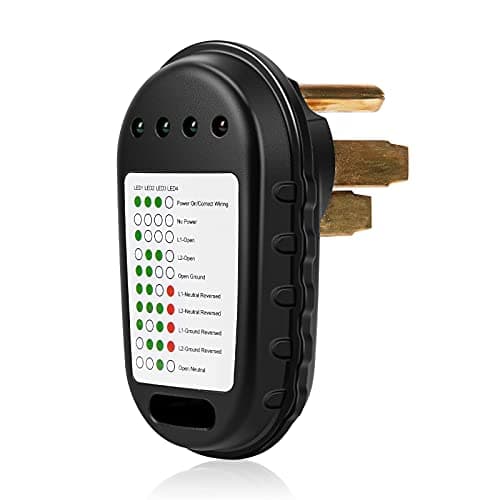
- 1. Receptacle and circuit analyzers — they test the outlet. You plug one into a NEMA 14-50 and it reports, on LEDs, whether the hots, neutral and ground are where they should be and whether the voltages are right. This is the supply side. It is cheap, it requires no skill, and it catches the fault that most often bites a home EV install: an outlet that someone wired wrong or wired on the wrong circuit.
- 2. Vehicle simulators — they test the charger. These present the resistances a real car presents, so the charging station runs through its state machine and energizes as though a vehicle were connected. That is the only way to find out whether an EVSE's control pilot, contactor and ground-fault protection are working, without risking a car.
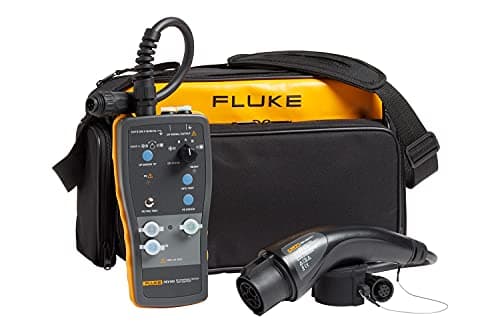
- 3. Professional adapter kits — they break the charger out to your instrument. Same vehicle simulation, plus terminals so a multimeter or oscilloscope you already own can measure voltage, current and pilot waveforms, plus dedicated protective-earth and GFCI trip tests. These are for commissioning and compliance work.
The cheap tool and the expensive tool do not substitute for each other in either direction. A receptacle analyzer will happily pass an outlet feeding a charger that is itself broken. A vehicle simulator will happily confirm a charger is behaving correctly while the receptacle behind it has a loose neutral. They answer different questions, and the first question to ask is which one you have.
The short version
- WELLUCK 50A RV Circuit Analyzer — best for almost everyone. Plugs into a 14-50, reads out on LEDs, states an ETL certification in the listing, and costs less than a charging cable holster. Sold for RV pedestals, which is why it is cheap, and the receptacle and the faults are identical to the EV case.
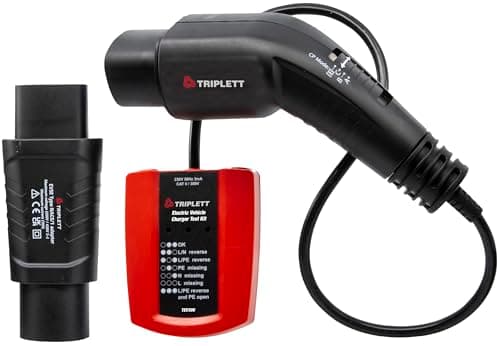
- Triplett TEV300 — best for actually testing a charger. A self-powered vehicle simulator with switchable control-pilot states, proximity-pilot simulation and GO/NO GO LEDs, shipped with a Type 1 (J1772) adapter. The cheapest honest way to interrogate an EVSE rather than an outlet.
- Fluke FEV100 — best for a working installer. Protective-earth pre-test, GFCI trip testing, pilot-state simulation and voltage and maximum-current verification through your own meter, specified by Fluke as SAE J1772 compliant to North American standards, with a three-year warranty. Remember that it is an adapter and needs an instrument.
Which one do you need?
- “An electrician just installed my 14-50 and I want to check it.” The WELLUCK. This is the single most common reason to own anything on this page, and it is a reasonable instinct: a miswired 240-volt receptacle is both the most likely fault and one of the few you can detect yourself in thirty seconds. Pair it with our NEMA 14-50 outlet guide, which covers what a correct installation looks like.
- “My charger will not start a session.” Work through EV charger troubleshooting and why does my EV stop charging first, because most of these turn out to be a setting, a schedule or a connector that is not fully seated. If you have exhausted that and need to divide the problem between the station and the car, the Triplett is the tool that divides it.
- “The breaker trips when I charge.” A tester is not your first move. EV charger tripping breaker and do I need a GFCI breaker for EV charging cover the common causes, several of which are nuisance trips from a GFCI breaker interacting with the charger's own built-in ground-fault protection rather than a fault at all.
- “I install chargers professionally.” The Fluke, if you already carry the meter. The Triplett if you want a self-contained go/no-go check for the van and do not want to break out an instrument on every call.
- “I want to know whether the circuit can carry 40 amps.” Nothing on this page tells you that, and it is important to say so. Conductor gauge and breaker rating are not visible to any plug-in tester. That is a question for the wire size and breaker guide and for looking at the actual breaker and the actual cable.
How the three compare
Published manufacturer and listing figures, with the live price alongside. Read the first column as the deciding one — what each tool is physically able to test.
| Tester | Best for | Published specs (manufacturer / listing) | Price |
|---|
| WELLUCK 50A RV Circuit Analyzer (14-50) | Checking a 14-50 outlet before you trust it | NEMA 14-50P · 50A · 125/250V · LED fault indicators · ETL Certified (per listing) | $19.95 |
| Triplett TEV300 EV Charger Test Kit | Testing whether the charger itself works | CP states A/B/C/E · Type 1 (J1772) adapter incl. · CAT II 300V · IP40 · GO/NO GO LEDs | $329.99 |
| Fluke FEV100 EVSE Test Adapter Kit | An electrician who already owns the meter | Simulates an EV · PE pre-test · GFCI trip · SAE J1772 (Type 1) · 3-year warranty | $1,021.22 |
#ad Prices read live from the Amazon Product API as of November 13, 2026, and they move. Specs are the manufacturer's published claims from the live listing — we have not bench-measured them. Where we have no verified price we print none rather than a number that has gone stale.
What a vehicle simulator is actually doing
This is worth understanding, because it is the difference between the twenty-dollar tool and the three-hundred-dollar one, and because it explains a lot of charging faults.
A J1772 connection is not a dumb socket. Before any power flows, the station and the car negotiate over two signal pins — the control pilot and the proximity pilot. The car signals its state by placing a specific resistance between the control pilot and protective earth, and the station reads that resistance to decide what to do. Triplett's kit reproduces those states with a switch: state A is open circuit, meaning nothing is plugged in; state B is 2.74k ohm, a vehicle connected but not ready; state C is 882 ohm, a vehicle ready to charge; and state E is 0 ohm, which reproduces a station-side control-pilot error so you can confirm the charger detects and refuses it.
The kit also simulates a 20-amp cable capability across the proximity pilot, so the station sees a plausible cable as well as a plausible car. That matters because a station that reads no valid cable rating will refuse to energize regardless of what the control pilot says — which, incidentally, is one real-world cause of a charger that lights up and never delivers power. Our J1772 connector explainer covers the pin functions, and Type 2 vs J1772covers why these tools are often documented as “Type 1” equipment.
What we left out, and why
The KPS EVCHECK2010US. It is a real, J1772 vehicle simulator with control-pilot state simulation and a CCID trip test, and it is in stock. We did not rank it because we could not reconcile its published electrical rating with the job: retailer listings give it as rated up to 10 amps and up to 130 volts AC, with a maximum single-phase input of 130 volts, while the same listings describe diagnosing Level 2 charge points. A Level 2 station is 240 volts. There is no manufacturer datasheet available to resolve the discrepancy, and we are not going to recommend a seven-hundred-dollar tool for 240-volt work on specifications we cannot stand behind. If KPS publishes a datasheet that clears this up, we will revisit it.
The FLIR EV86-NACS analyzer. A capable instrument and the only NACS-native analyzer we found, but it is the most expensive item in the category by some distance and stock was down to a couple of units when we checked. We are not comfortable making a four-figure recommendation on that depth of supply.
Unbranded “go/no-go” pocket testers. There is a tail of these on the marketplace with no manufacturer name, no published electrical rating and no measurement category. At the price of the WELLUCK you can have a tool with an ETL mark on the listing; there is no reason to gamble.
Clamp meters and multimeters generally. Useful, but not EVSE testers — they measure what is happening, they do not make a station think a car is present. If you already own one, the Fluke adapter is what turns it into an EVSE tester.
The honest conclusion
Most people reading this do not need a tester at all. If a licensed electrician installed your circuit, pulled a permit and had it inspected, the inspection isthe test, and a twenty-dollar analyzer is cheap reassurance rather than a necessity. If a charger is misbehaving, the cause is far more often a setting, a schedule, a Wi-Fi problem or a connector that is not seated than a hardware fault — see EV charger troubleshooting and EV charger Wi-Fi connection problems. Buy the outlet analyzer because it is genuinely useful and genuinely cheap. Buy a simulator when you have a specific fault to isolate. Buy the Fluke when it is a work expense. And if the real conclusion is that the charger itself is the problem, the reviews index is where to start looking for its replacement.
The criteria we ranked on
What it is physically able to test. The dominant criterion, and the one that makes a straight price ranking meaningless here. A tool that tests the outlet and a tool that tests the station are not competitors. We ranked the outlet analyzer first because it matches what most readers are actually asking, not because it is the most capable instrument — it is plainly the least capable, and it says so on its own card.
Whether it works on its own. The Fluke is an adapter and needs a multimeter or oscilloscope; the Triplett is self-powered from the charging system and needs nothing; the WELLUCK needs nothing. That distinction changes the real cost of ownership more than the sticker price does, and it is the single thing buyers most often miss in this category.
A measurement category and a published rating. Both the Triplett and the KPS unit publish a CAT II 300V measurement category; the Triplett adds IP40. CAT ratings exist because a tool connected to a 240-volt circuit has to survive a transient, and a tool that publishes no category on a 240-volt circuit is not a tool we will rank. This criterion is also why the KPS unit is discussed rather than listed — it publishes a rating, but one that does not match the stated application.
Specified for North America, not adapted to it. Much of this category is European equipment with a Type 1 adapter in the box, which is workable but means the documentation describes 230/400V three-phase systems you do not have. Fluke states SAE J1772 compliance with North American standards; Triplett publishes a 230/400V input rating and ships a Type 1 adapter. Both are usable at US 240 volts inside CAT II 300V, and we say which is which rather than pretending the distinction does not exist.
Safety listing where one is meaningful. For the plug-in outlet analyzer, the listing states ETL certification, which is what we want on a device a non-electrician puts into a 50-amp receptacle. Test instruments are governed by measurement category rather than by a UL listing on the box, which is why the criterion is applied differently across the tiers.
What it cannot tell you, stated up front. No tool here reveals conductor gauge or breaker size, and none of them is a substitute for an inspection. We would rather rank three tools and spell out the gap than imply that a plug-in device certifies an installation. Our research method sets out what our scores mean: judgments from published specifications and listings, not bench measurements.