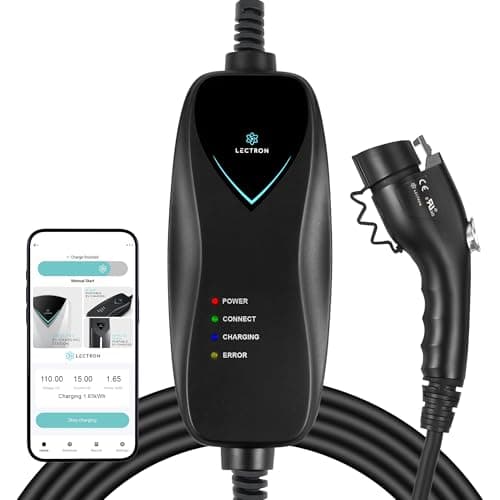
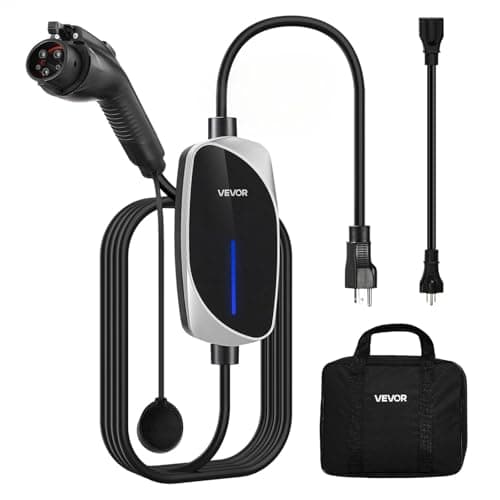
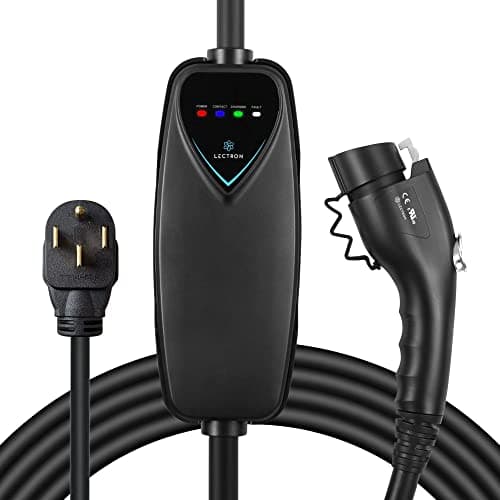
The best EV charger under $300 is the Lectron Level 2 (40A), and it is for the buyer who wants a charger that lives on the wall rather than in the trunk: a full 40 amps, an ETL listing, a J1772 handle and a NEMA 14-50 plug, for the least money anyone charges for that combination. The budget pick is the VEVOR Level 1 & 2 (16A)— the lowest-priced charger in our registry, dual-voltage, and the right answer when the car only needs topping up. If the charger has to live outdoors, the WOLFBOX Portable is the one that publishes an IP66 enclosure rating and still lands inside the band.
Every price on this page is read from the live Amazon feed and carries its own date stamp, so the band is a real band rather than a remembered one — a page that hardcodes prices is wrong within a month, and a $300 ceiling is exactly the kind of claim that rots. Any product whose price the feed could not verify on the last refresh is not on this page at all. We compile published manufacturer specs and safety listings, read the live listing and do the circuit arithmetic; we have not bench-tested these units and do not claim to have. See how we research, and we may earn a commission.
What the extra hundred dollars buys over the $200 band
We also rank chargers under $200, and the honest summary of that page is: under $200, every product is a cord. A plug on one end, a handle on the other, electronics in a box in the middle, and nothing designed to be bolted to a wall and left there for a decade.
Between $200 and $300, three things become available, and they are the only reasons to spend the extra money:
- A wall-mountable 40-amp unit.The Lectron Level 2 is a wall unit on a 14-50 plug rather than a cord in a bag — the cheapest charger in our registry designed to be mounted and left there, and it ships with a 16-foot extension cord for reach. At 40 amps it delivers 9.6 kW, the same rate as plug-in wall chargers costing three times as much on the same circuit.
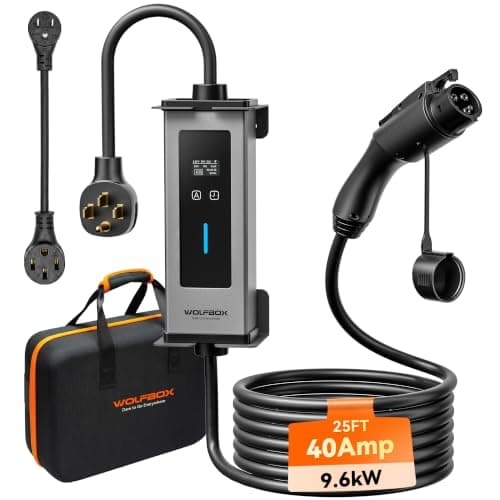
- A published outdoor rating. The WOLFBOX publishes an IP66 enclosure rating, which covers hose-directed water, plus an ETL listing. Most cords under $200 publish neither, and leaving an unrated cord in the weather is the fastest way to turn a cheap charger into a dead one. Can you leave a portable charger outside is the long answer.
- Real cable length. Five of the seven picks publish a 25-foot cable. Sixteen feet looks fine on a listing and runs out halfway across a garage. Cable length is the most common regret in this category, ahead of amperage and well ahead of app features.
What the band does not buy is 48 amps, hardwiring, load management or a metal enclosure. Those start above it, and best EV chargers under $500 is where they live.
The band in one table
| Charger | Best for | Key specs (manufacturer) | Price |
|---|
| Lectron Level 2 (40A) | A simple, inexpensive plug-in charger | 40A / 9.6kW · J1772 · NEMA 14-50 plug · ETL · 16ft extension | $246.49·Amazon |
| WOLFBOX Portable (Level 1/2) | One charger for home and travel | 6–40A · 9.6kW · J1772 · Level 1/2 · NEMA 14-50 + 5-15 · ETL · IP66 · 25ft | $254.99·Amazon |
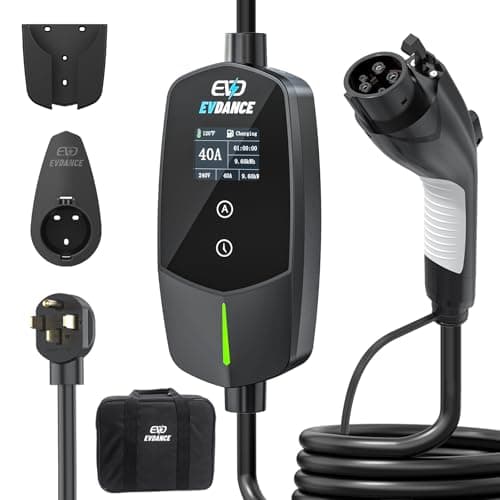
| EVDANCE 40A Portable | Off-peak charging without an app | 40A / 9.6kW · J1772 · NEMA 14-50 plug · 25ft, timer | $199.98·Amazon |
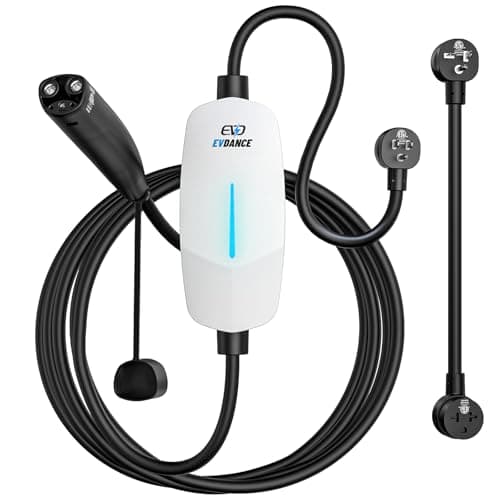
| EVDANCE NACS Mobile Connector (12A/16A) | Tesla and other NACS cars | 12A @ 120V / 16A @ 240V · NACS (J3400) · NEMA 5-15 + 6-20 · 25ft cable | $127.45·Amazon |
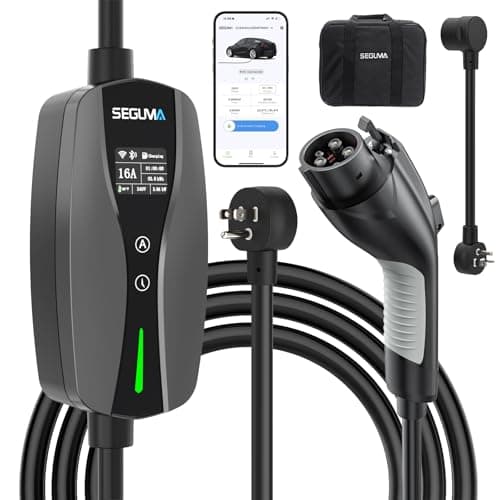
| SEGUMA Wi-Fi Level 1/2 (12A/16A) | A 120V backup that is not dumb | 12A @ 120V / 16A @ 240V · J1772 · NEMA 5-15 + 6-20 adapter · ETL certified · 25ft | $129.99·Amazon |
| Lectron Level 1 WiFi (120V, 15A) | Scheduling and monitoring on 110V | 15A @ 120V · J1772 · NEMA 5-15 plug · Wi-Fi · 16ft | $169.99·Amazon |
| VEVOR Level 1&2 (16A, 25ft) | The lowest price on a dual-voltage cord | 16A · 120V or 240V · J1772 · NEMA 6-20P + 5-15 adapter · 25ft cable | $111.90·Amazon |
#ad · Prices read live from the Amazon Product API as of November 21, 2026, and they move. Specs are the manufacturer's published claims from the live listing — we have not bench-measured them. Where we have no verified price we print none rather than a number that has gone stale. We may earn a commission.
The split that decides your pick: 240 volts or 120
Under $300 the field divides into two groups that look similar on a listing page and do wildly different jobs. Buying the wrong one is the expensive mistake in this band, and it is easy to make because both are sold as “EV chargers”.
240-volt (Level 2) units— the Lectron Level 2, the WOLFBOX and the EVDANCE 40A — plug into a dryer-style or welder-style outlet and draw 16 to 40 amps. At 40 amps that is roughly 25 to 30 miles of range per hour, which is full Level 2 speed and enough to refill almost any EV overnight. They require a 240-volt outlet to exist. If one does not, adding a NEMA 14-50 receptacle is an electrician's half-day and usually costs more than any charger on this page — our installation cost guide has the real ranges, and NEMA 14-50 outlets covers the receptacle itself.
120-volt and dual-voltage units— the SEGUMA, the Lectron Level 1 WiFi, the VEVOR and the EVDANCE NACS cord — plug into an ordinary household socket and draw 12 to 16 amps, adding roughly 3 to 5 miles of range per hour. That is genuinely enough for a plug-in hybrid, a short commute or a second car, and genuinely not enough for a long-range EV you drain daily. The dual-voltage ones do either, at 16 amps on 240 volts. 120V vs 240V charging runs the arithmetic, and can you live with only Level 1 answers the question honestly rather than selling up.
So the first question is not which charger, it is which outlet. If the garage has a 240-volt receptacle, buy the Lectron Level 2 or the WOLFBOX and you are done. If it has a normal socket and you are not ready to pay an electrician, buy a dual-voltage cord now — it keeps working at 16 amps the day you do add the outlet.
What we would buy, by situation
One car, a 14-50 outlet, wants it on the wall.The Lectron Level 2. It is the only unit in the band meant to live on a wall rather than coil into a bag, and 40 amps is the legal ceiling for any plug-in charger anyway, so you are not giving up speed to a $500 plug-in unit — only features.
Charger lives outside, or travels. The WOLFBOX, for the published IP66 rating and the 5-15 adapter that lets it fall back to a household socket at a hotel. It is the most versatile single purchase in the band.
Tesla or another NACS car. The EVDANCE NACS Mobile Connector, which has the native Tesla-style handle so nothing hangs off the end. For a NACS car that wants a wall box under $300 there is nothing in the band; the honest answer is best NACS home chargers or a J1772 unit from this page plus a certified adapter, which our adapter roundup ranks on the safety listing.
Off-peak charging on a time-of-use rate. The EVDANCE 40A has a built-in timer and the Lectron Level 1 WiFi has an app, so either can start charging at midnight without the car doing the scheduling. If your car already schedules its own charging, do not pay for this twice.
The cheapest thing that is not a mistake.The VEVOR dual-voltage cord. It is the lowest price in our whole registry, publishes a 25-foot cable, and includes both a 6-20 plug and a 5-15 adapter. Sixteen amps is the compromise you are making — and we would still rather sell you this than an unlisted 40-amp cord from a brand with no certification anywhere on the listing.
The two things nothing in this band does
It does not hardwire. Every 240-volt unit here terminates in a plug, which caps it at 40 amps by code and means it cannot reach the 48 amps a car with an 11.5 kW onboard charger can accept. If you want that, you want a 48-amp unit from the hardwired roundup on a 60-amp circuit. The car-led version of the same decision is chargers for a Cadillac Lyriq, where the vehicle's onboard module, not the budget, sets the amperage.
It does not manage your panel.Load management — the feature that measures house draw and backs the charger off instead of tripping the main — does not exist at this price. On a tight 100-amp service that is not a luxury; it is the thing that makes the install permissible at all. Chargers with load management is the category and chargers for a 100-amp panel is the situation.
One more thing worth saying plainly about cheap chargers: the certification is not optional. Several 40-amp cords sell for under $200 with no UL, cUL or ETL listing named anywhere in the listing text. A 40-amp continuous load in an attached garage is the last place to save thirty dollars, and none of those units appear here at any price. The listing-ranked version of that argument is best UL-listed EV chargers.
The criteria we ranked on
1. A live price under $300, verified the day this page was written. That is the gate. Ten chargers in our registry cleared it on the 2026-11-15 refresh; a product whose price the feed could not confirm is not ranked here, because an under-$300 page whose picks are not actually under $300 is worse than no page at all. The numbers you see are the feed's, with the feed's date on them.
2. Can it be installed, or only coiled? We ranked the one wall-mountable 40-amp unit first on purpose. At this price the difference between a unit that mounts on the wall and one that coils into a bag is the difference between a permanent home charging setup and a stopgap, and it is the only structural upgrade this band offers over the $200 band below it.
3. A named third-party safety listing. Every pick names a UL, cUL or ETL listing in its live retail listing. This is a gate, not a score. The budget end of this category is full of 40-amp units that name no standard at all, and we would rather rank a 16-amp certified cord above an uncertified 40-amp one — which is exactly what the ranking does.
4. Cable length, which buyers underestimate and then regret. Twenty-five feet reaches across a double garage; sixteen feet reaches the car only if you park it right. We weighted the published length heavily because it is the complaint that comes up more than any other in this price band. EV charger cable length has the measuring method.
5. Does it cover both voltages? A dual-voltage cord works off a household socket today and off a 240-volt outlet the day you add one. In a band where many buyers do not yet have a 240-volt circuit, that flexibility is worth more than a few extra amps, and we scored it that way.
6. Whether the smart features are real. A timer that delays the start is useful on a time-of-use rate. An app that reports kilowatt-hours is pleasant. Neither is worth a premium inside this band, and we did not promote any unit for having Wi-Fi alone.
What we did not score. We did not measure charge rates, connector durability or cold-weather cable stiffness ourselves. Those are manufacturer claims and owner reports, sourced below, and where a maker publishes no figure we leave the gap visible.