Skip to content
Volt & Cable

HUB 04 · Cable Management & Accessories

The Best EV Charger Splitters

A splitter shares one 240-volt circuit between two loads instead of adding a circuit. Ranked on safety listing first, because the cheap ones state none.

By Stephen V.Updated How we research
#ad

We earn a commission when you buy through our Amazon links, at no extra cost to you. It never affects our rankings, and we say so when the cheaper product is the better buy. How this works.

The short answer

Quick picks

#ad · Live prices from the Amazon Product API, as of November 24, 2026. Where we have no verified live price, we show none — we would rather leave a gap than print a number that has gone stale.

The best EV charger splitter is the IronWatt Smart Splitter if the circuit you are splitting is a genuine NEMA 14-50: it is the only unit here that passes a full 40 amps, it switches automatically between two 14-50 receptacles, and it is ETL certified. If what you have is a dryer outlet— which is the usual reason people land here — the pick is the islewire Smart Dryer Splitter, the cheapest ETL-certified automatic unit and the only one that fits the older three-prong NEMA 10-30 receptacle. The budget pick is the manual EV / dryer switch: ETL listed, internal breaker, a knob you turn yourself. One number governs all of this: on a 30-amp dryer circuit, the continuous limit is 24 amps, no matter what the splitter is rated for.

Every price on this page is read from the live Amazon feed and stamped with its own date, so the ranking reflects what things cost today rather than what they cost when this page was written. We compile published manufacturer specs and safety listings, read the live listing, and do the circuit arithmetic; we have not bench-tested these units and we do not claim to have. Our research method sets out exactly what our scores are and are not. Where a maker does not publish a figure, we say so instead of filling it in. We may earn a commission.

What a splitter actually does — and does not

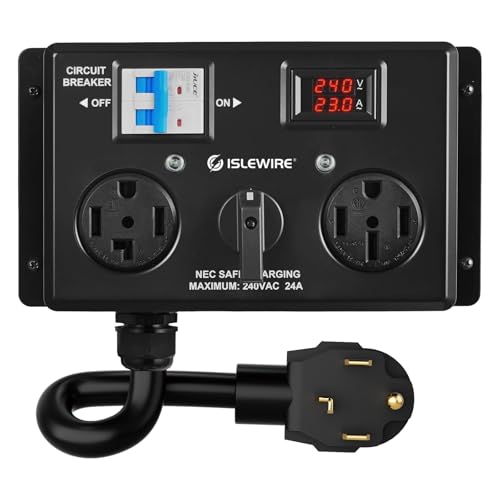
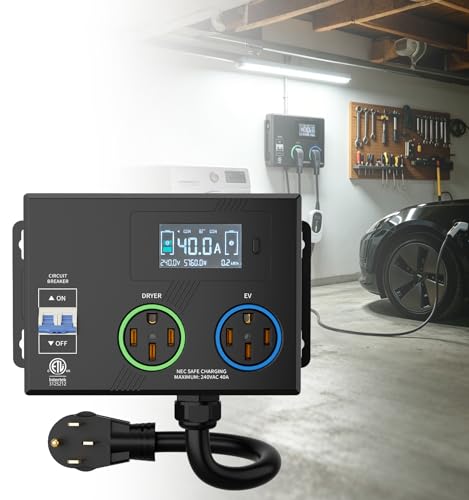
A splitter plugs into an existing 240-volt receptacle and gives you two receptacles out. It does notcreate capacity. The circuit behind it is the same circuit, with the same breaker and the same conductors, and the splitter's job is to make sure only one of the two outlets is energized at a time. The automatic units sense which load is calling for power and switch; the manual unit asks you to choose.

That is the whole value proposition, and it is a real one: it replaces a new circuit. Running a dedicated 240-volt circuit to a garage means an electrician, possibly a permit, and a spare pair of breaker spaces you may not have. A splitter needs none of those. Our installation-cost guide covers what you are avoiding, and our 100-amp panel roundup covers the situation where there is no room to add one at all.

What a splitter cannot do is charge two cars at once, or let the dryer run while the car charges. Every device on this page switches. If a listing anywhere implies simultaneous operation on one circuit, that listing is wrong about electricity.

The 24-amp rule, which decides your whole shortlist

An EV charger is a continuous load, and the code sizes continuous loads at 125 percent of the load — which in practice means a circuit can be loaded to 80 percent of its breaker rating for hours on end. So:

  • A 30-amp dryer circuit (NEMA 14-30 or 10-30) tops out at 24 amps for charging. Roughly 5.8 kW, or about 18 to 20 miles of range an hour. Every 30-amp-circuit splitter here is rated exactly 24 amps for that reason, and your charger has to be set to 24 amps or less to use one.
  • A 50-amp circuit (NEMA 14-50) tops out at 40 amps.That is where the 40-amp splitters earn their money — about 9.6 kW, or roughly 30 miles an hour.

This is why the first question is not “which splitter” but “which receptacle”. Go and look at the outlet. Four slots in a round face with an L-shaped one at the top is a 14-30 or 14-50; three slots is a 10-30. Our outlet types guide has the shapes side by side, and 10-30 versus 14-50 and 14-30 versus 14-50explain what each circuit can and cannot do. If you can set your charger's current, how to set the amps is the step people skip and then wonder why the breaker trips.

The picks, with live prices

SplitterBest forKey specs (manufacturer)Price
IronWatt Smart Splitter (14-50 to dual 14-50, 40A)Splitting an existing NEMA 14-50 circuit14-50P in · dual 14-50R out · 40A maximum · Automatic switching · ETL certified$189.99Amazon
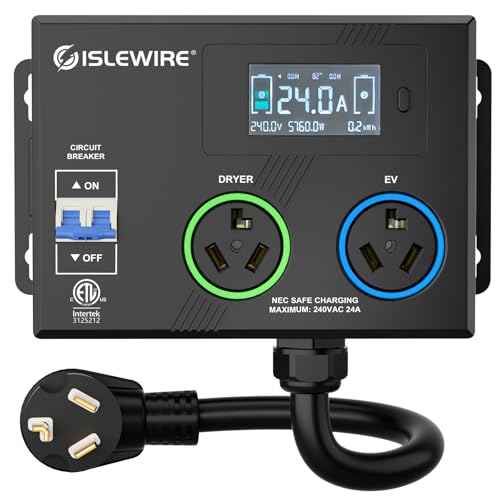
islewire Smart Dryer Splitter (24A, NEMA 10-30)An older three-prong 10-30 dryer outletNEMA 10-30 input · 24A charging limit · Automatic switching · ETL certified$145.99Amazon
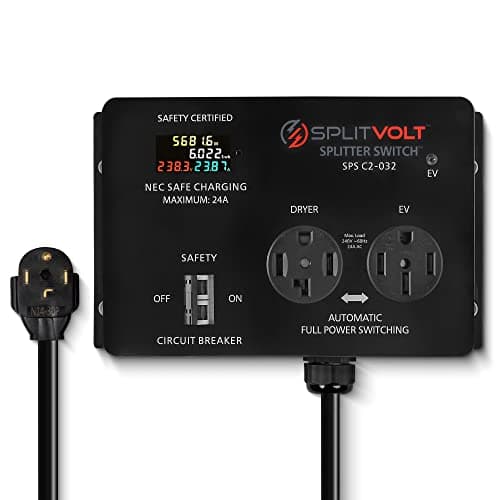
Splitvolt Splitter Switch (14-30/14-50)A full panel with a dryer outlet in itShares a 30A dryer circuit · 24A max for charging · 14-30 in · dryer + EV out · cETLus certified$312.00Amazon
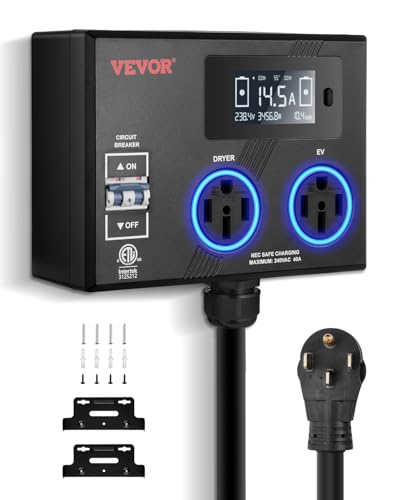
VEVOR NEMA Splitter (14-50 to dual 14-50, 40A)A 14-50 split on the smallest budget14-50P in · dual 14-50R out · 40A maximum · LCD + 3-color LED · “Tested to ETL Standard”$152.90Amazon
Manual EV / Dryer Switch (24A, 14-30)The cheapest safe way to share a 14-30 dryer circuit14-30P in · 14-30R + 14-50R out · 24A charging limit · Manual selector · ETL listed$85.99Amazon

#ad · Prices read live from the Amazon Product API as of November 24, 2026, and they move. Specs are the manufacturer's published claims from the live listing — we have not bench-measured them. Where we have no verified price we print none rather than a number that has gone stale. We may earn a commission.

How we ranked them

Safety listing first, and it is not a formality in this category. A splitter carries the full circuit current through a plug-in plastic housing, often in a laundry room, for hours at a time. A named listing — ETL Listed, ETL Certified, cETLus — means a laboratory evaluated the thing. Several splitters on the retailer state nothing at all, and one of our own picks states something weaker than a listing: the VEVOR says “Tested to ETL Standard”, which is not the same claim as being listed to it, and we have said so in its entry rather than quietly letting the ETL letters do work they have not earned.

Then capacity, because 40 amps versus 24 is the difference between 30 and 19 miles of range an hour and it is set by your circuit, not your preference. Then switching behavior — automatic units are worth real money over a manual selector if the outlet is anywhere inconvenient. Then the receptacle match, which is a hard constraint rather than a score. Then live price.

We have not bench-tested any of these devices. Every specification here comes from the live listing and every price from the feed; our research method sets out what that does and does not entitle us to say.

Which one for your situation

You have a NEMA 14-50 and two EVs. The IronWatt. Two 14-50 receptacles, 40 amps, automatic switching, ETL certified. The VEVOR does the same arrangement for less, and the reason it ranks below is its weaker certification wording, not its hardware.

You have a four-prong 14-30 dryer outlet. The Splitvolt Splitter Switch or the manual switch. The Splitvolt is the established part with an internal breaker, a live power display and a cETLus certification; the manual switch costs a fraction of it and gives you both a 14-30 and a 14-50 outlet, at the cost of walking out to turn a knob. Our Splitvolt review goes deeper on that unit specifically.

You have a three-prong 10-30 dryer outlet.The islewire, which is the only pick here that fits it. One caveat we would rather state than skip: a 10-30 circuit has no separate equipment-grounding conductor, so the installation inherits whatever grounding arrangement the old receptacle has. The device is plug-and-play; the circuit behind it deserves an electrician's glance.

You are deciding whether to split at all. Read can I use a dryer outlet for EV charging first. A splitter is the right answer when adding a circuit is genuinely off the table. When there is panel space and a reasonable cable route, a dedicated circuit is faster, permanent and not competing with the laundry.

Splitter versus the alternatives

Versus a plain outlet adapter.An adapter lets a 14-50 charger plug into a 14-30 receptacle, but it does not give the dryer an outlet back — you unplug one to use the other. It is also much cheaper. If you rarely run both, an adapter from our outlet adapter roundup may be all you need, with the same 24-amp ceiling.

Versus a second charger. If the goal is two EVs, compare a splitter against a single dual-cable charger. Our two-EV roundup ranks the units built for it, and charging two EVs in one household works through the scheduling. A splitter is the cheaper route; a dual-cable charger is the tidier one.

Versus load management.A charger with dynamic load management watches the whole house and reduces its own draw instead of switching outlets. That is a different and generally better answer when the constraint is the service rather than one circuit — see chargers with load management.

Safety points worth being blunt about

Set the charger, not just the splitter.A 24-amp splitter does not stop a 40-amp charger from trying to pull 40 amps; the internal breaker will simply trip, repeatedly. Set the charger's current limit first.

Check the receptacle itself. A dryer outlet that has sat unloved for thirty years is now going to carry near its rating for hours a night. Discolored slots, a loose plug fit or a warm faceplate mean the receptacle needs replacing before anything else happens. The same logic applies to the 14-50 receptacle on a plug-in charger install.

Do not stack adapters on a splitter. Each extra set of contacts in a high-current path is another place to develop heat. If the plug does not match, buy the splitter that matches instead of adapting around one that does not.
In detail

The picks, in full

01
IronWatt IronWatt Smart Splitter (14-50 to dual 14-50, 40A)

Splitting an existing NEMA 14-50 circuit

IronWatt Smart Splitter (14-50 to dual 14-50, 40A)

14-50P in · dual 14-50R out40A maximumAutomatic switchingETL certified
8.5/10

The only splitter here that passes a full 40 amps, and the one to buy if the circuit you are splitting is a real 14-50 rather than a dryer outlet.

Capacity
9
Safety listing
8
Convenience
9
Value
8

Pros

  • 40 amps is twice the charging current of the 24-amp dryer-circuit splitters, so on a 50-amp circuit you keep the full speed your charger was bought for
  • Two 14-50 receptacles out means it handles the two-EV case directly, switching the circuit between cars rather than asking you to move a plug in the dark
  • ETL certified, which is a named safety listing — most of the cheap splitters on this retailer state nothing at all
  • The LCD and three-color LED tell you which outlet is live without opening anything, which matters on a device whose entire job is that only one side is energized

Cons

  • It switches between the two outlets — it does not power both at once. Two EVs charge one after the other, not together, and nothing in this category changes that
  • IronWatt is a newer name with far less field history than Splitvolt, so you are buying the ETL listing rather than a reputation
  • Stock was under twenty units on our last check
  • If what you have is a 30-amp dryer outlet, the 40-amp rating is wasted — the circuit, not the splitter, sets the ceiling

Don't buy this if…

…you are splitting a dryer circuit. On a 30-amp circuit the continuous limit is 24 amps whatever the splitter is rated for, so the cheaper 24-amp units lose you nothing.

$189.99View on Amazon

Price as of November 24, 2026. Prices change — Amazon's is the one that counts.

#ad · we may earn a commission from this link to IronWatt Smart Splitter (14-50 to dual 14-50, 40A)

02
islewire islewire Smart Dryer Splitter (24A, NEMA 10-30)

An older three-prong 10-30 dryer outlet

islewire Smart Dryer Splitter (24A, NEMA 10-30)

NEMA 10-30 input24A charging limitAutomatic switchingETL certified
8.0/10

The cheapest ETL-certified automatic splitter, and the one that fits the three-prong 10-30 dryer outlet older houses actually have.

Capacity
6
Safety listing
8
Convenience
9
Value
9

Pros

  • Fits NEMA 10-30, the three-prong dryer receptacle in houses wired before the four-prong 14-30 became standard — a configuration most splitters ignore
  • ETL certified and automatic: it gives priority to whichever load calls for power and switches back, so the dryer keeps working without anyone thinking about it
  • Well under half the price of the Splitvolt for the same 24-amp ceiling and the same basic function
  • Needs no rewiring and no electrician, which is the entire reason this category exists

Cons

  • 24 amps is roughly 5.8 kW — about 18 to 20 miles of range an hour. Fine overnight, slow if you need a top-up before dinner
  • A 10-30 circuit has no separate ground conductor, so the install inherits whatever the old receptacle's grounding arrangement is. Worth an electrician's opinion even though the device itself is plug-and-play
  • islewire is an unfamiliar brand; the ETL listing is the reason to trust it, not the name
  • Your charger has to be set to 24 amps or less, and not every charger lets you set it that low

Don't buy this if…

…your dryer outlet is a four-prong 14-30 or you have a 14-50. Buy the matching version instead of adapting around this one — a splitter is already a compromise and stacking adapters on it is worse.

$145.99View on Amazon

Price as of November 24, 2026. Prices change — Amazon's is the one that counts.

#ad · we may earn a commission from this link to islewire Smart Dryer Splitter (24A, NEMA 10-30)

03
Splitvolt Splitvolt Splitter Switch (14-30/14-50)

A full panel with a dryer outlet in it

Splitvolt Splitter Switch (14-30/14-50)

Shares a 30A dryer circuit24A max for charging14-30 in · dryer + EV outcETLus certified
7.8/10

Shares the dryer circuit you already have instead of adding one — the only pick here that needs no electrician and no spare breaker space.

Usefulness
9
Safety listing
9
Build quality
7
Value
6

Pros

  • Plugs into an existing NEMA 14-30 dryer receptacle and gives you a dryer outlet and an EV outlet, so no new circuit, no new breaker and no panel work
  • Switches the circuit between the two automatically, and an internal safety breaker holds EV charging to the 24-amp continuous limit a 30-amp circuit allows
  • cETLus certified with a live power display — a named safety listing, which most of the cheap dryer splitters on Amazon do not state

Cons

  • 24 amps is the ceiling — roughly 5.8 kW, well short of a 40- or 48-amp circuit, and your charger has to be set to 24 amps or less
  • Costs about as much as a decent charger, so the saving is against an electrician's bill, not against a cheaper charger
  • Only one device draws at a time, and it depends on your dryer outlet being in a place you can actually park near

Don't buy this if…

…you have room in the panel for a dedicated circuit. A properly installed 240-volt circuit is faster, permanent and not competing with the laundry — this is the answer when adding one is genuinely off the table.

$312.00View on Amazon

$390.0020% off

Price as of November 24, 2026. Prices change — Amazon's is the one that counts.

#ad · we may earn a commission from this link to Splitvolt Splitter Switch (14-30/14-50)

04
VEVOR VEVOR NEMA Splitter (14-50 to dual 14-50, 40A)

A 14-50 split on the smallest budget

VEVOR NEMA Splitter (14-50 to dual 14-50, 40A)

14-50P in · dual 14-50R out40A maximumLCD + 3-color LED“Tested to ETL Standard”
7.5/10

The cheapest way to split a 14-50 circuit at 40 amps — undercut only by its own paperwork, because the listing claims testing to a standard rather than a listing to it.

Capacity
9
Safety listing
5
Convenience
8
Value
8

Pros

  • The same 40-amp, dual-14-50 arrangement as the IronWatt for noticeably less money
  • VEVOR is at least a known quantity on this retailer with a real returns process behind it, which is not true of every splitter in these search results
  • An LCD readout and an indicator ring make the live side obvious at a glance

Cons

  • The listing says “Tested to ETL Standard”, which is not the same claim as ETL Listed or ETL Certified. On a device carrying 40 continuous amps through a plug-in housing, that distinction is the whole reason to pay more for the IronWatt
  • No published UL or ETL file number on the listing, so there is nothing to look up
  • Switches between outlets rather than running both, like every splitter here
  • VEVOR sells across dozens of unrelated categories; support depth on an electrical part is not the same as a specialist's

Don't buy this if…

…a named safety listing matters to you — and on a 240-volt plug-in device sharing a circuit, it should. Pay the extra for the ETL-certified IronWatt or the cETLus-certified Splitvolt.

$152.90View on Amazon

Price as of November 24, 2026. Prices change — Amazon's is the one that counts.

#ad · we may earn a commission from this link to VEVOR NEMA Splitter (14-50 to dual 14-50, 40A)

05
Unbranded (ETL listed) Manual EV / Dryer Switch (24A, 14-30)

The cheapest safe way to share a 14-30 dryer circuit

Manual EV / Dryer Switch (24A, 14-30)

14-30P in · 14-30R + 14-50R out24A charging limitManual selectorETL listed
7.3/10

The budget pick: a hand-operated selector with an internal breaker and an ETL listing, for a fraction of the Splitvolt's price. You turn a knob instead of letting electronics decide.

Capacity
6
Safety listing
8
Convenience
5
Value
10

Pros

  • ETL listed and fitted with its own safety breaker, which is the same protective idea as the Splitvolt at a fraction of the money
  • Gives you both a 14-30 and a 14-50 receptacle, so the dryer plugs back in and the charger plugs in without a second adapter
  • A mechanical selector cannot mis-sense a load or fail to switch back — there is less to go wrong than in the automatic units, and you can see which way it is set
  • By far the cheapest entry in the category, which makes the dryer-circuit route genuinely affordable rather than nearly charger-priced

Cons

  • You have to walk out and turn it. If you forget, either the car did not charge or the laundry did not run — the automatic units exist precisely because people forget
  • No brand to speak of on the listing, so the ETL listing is all the assurance there is
  • 24-amp ceiling, same as every 30-amp-circuit device here, and your charger must be set to match
  • Only fits a four-prong 14-30; a three-prong 10-30 house needs the islewire instead

Don't buy this if…

…the outlet is somewhere inconvenient — a basement laundry behind a door, say. The whole value of the automatic splitters is that nobody has to go there twice a day.

$85.99View on Amazon

Price as of November 24, 2026. Prices change — Amazon's is the one that counts.

#ad · we may earn a commission from this link to Manual EV / Dryer Switch (24A, 14-30)

How we picked

We do not run a testing lab

We compiled published specifications from manufacturer manuals and spec sheets, verified the safety listings (UL / ETL), computed the real running and installation costs, checked the wiring math against the NEC continuous-load rule, and read aggregated owner reviews — then scored each product against a published rubric. The scores are judgments from documented research — they are not bench measurements, because we do not have a test lab and we are not going to pretend we do. Every spec and cost figure is cited in Sources.

Questions

Frequently asked

Can a splitter charge two EVs at the same time?

No. Every splitter here switches the circuit between its two outlets, so the cars charge one after the other. If you need two cars charging simultaneously you need two circuits, or a single dual-cable charger that divides one circuit deliberately — see our two-EV roundup.

Why is everything limited to 24 amps?

Because the splitters built for dryer circuits are on 30-amp circuits, and a continuous load on a 30-amp circuit is limited to 24 amps. The two 40-amp units here are for 50-amp 14-50 circuits, where the same rule allows 40.

Do I need an electrician to fit one?

Not for the splitter itself — they plug into an existing receptacle. It is still worth having an electrician look at an old dryer outlet that is about to carry a continuous load for hours a night, and a 10-30 circuit in particular is worth a professional opinion.

Is a splitter safe?

A listed one, used within its rating and with the charger set correctly, is a normal piece of electrical equipment. An unlisted one carrying 40 continuous amps through a plastic housing is a gamble, which is why safety listing is the first thing we rank on.

Will my charger work on 24 amps?

Most adjustable chargers go that low; some cheap plug-in units do not adjust at all. Check before you buy the splitter — adjustable-amperage chargers are the ones that definitely can.

Are the prices on this page current?

They are read from the Amazon Product API and stamped with the date of the last successful refresh, printed on every button and table. If the feed goes stale the numbers disappear and the buttons fall back to “Check price on Amazon” — we would rather show a gap than a figure that has moved.

Keep reading

Receipts

Sources

We do not run a testing lab, and we do not pretend to. Where a measured number came from someone else's lab, we name them and link them. Where we could not verify something, we say so on the page rather than quietly leaving it out. Read our full method.