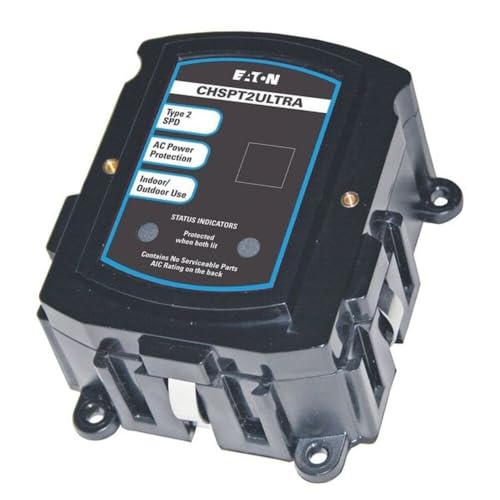
The best surge protector for an EV charger is the Eaton CHSPT2ULTRA— and the important part of that sentence is that it does not go anywhere near the charger. It goes at your electrical panel. There is no consumer surge strip rated for a continuous 40-amp, 240-volt load, so protecting a charger means protecting the service that feeds it with a Type 1 or Type 2 surge protective device (SPD). The Eaton wins on the combination of a 108,000-amp listed rating, a UL 1449 3rd-edition listing and a price that is a rounding error against a charger install. The budget pick is the Eaton CHSPT2SURGE, which carries the same classification and listing for about half as much. Before you buy either, read the next section: since the 2020 NEC your panel may already be required to have one.
Every price on this page is read from the live Amazon feed and stamped with its own date, so the ranking reflects what things cost today rather than what they cost when this page was written. We compile published manufacturer specs and safety listings, read the live listing, and do the circuit arithmetic; we have not bench-tested these units and we do not claim to have. Our research method sets out exactly what our scores are and are not. Where a maker does not publish a figure, we say so instead of filling it in. We may earn a commission.
Read this before you buy anything
NEC 230.67, introduced in the 2020 code, requires services supplying dwelling units to be provided with a surge protective device — a Type 1 or Type 2 SPD, integral to or immediately adjacent to the service equipment. Replacing service equipment triggers the requirement too; it is not grandfathered away. So if your panel is new, or your EV project includes a panel upgrade, the SPD may already be in the quote or already on the wall.
That makes this the rare product page where the first honest answer is “ask before you spend”. Ask the electrician quoting your charger circuit whether the service already has an SPD. If it does, you are done and you should buy nothing on this page. If it does not, you are buying one of the devices below and having it fitted at the same visit, which is far cheaper than a separate call-out. Our guide to EV charger surge protection walks through the code language in full.
Why there is no “EV charger surge protector”
People search for one because an EV charger is usually the most expensive thing they have ever had hardwired into a house, and the instinct to protect it is sound. The instinct to protect it at the charger is what sends buyers wrong, for three concrete reasons.
- Most Level 2 chargers are hardwired.There is no plug and no socket, so there is nowhere to insert a strip. The conductors run from the breaker to the charger's terminal block. See our hardwired charger roundup for what that install looks like.
- Where there is a plug, it is a 50-amp 240-volt receptacle. Surge strips are not made in the NEMA 14-50 configuration, and anything claiming to be one for a continuous 40-amp load deserves real suspicion.
- Adding contacts to a high-current path makes things worse, not better. Every extra set of contacts carrying 40 amps for eight hours is another place for resistance and heat to develop. It is the same reason we are careful about outlet adapters and why a warm breaker is worth taking seriously.
A panel-level SPD sidesteps all of that. It clamps transients on the way in, for the charger and for everything else on the service, and it is a part your electrician fits in minutes with the panel already open.
The picks, with live prices
| Surge protective device | Best for | Key specs (manufacturer) | Price |
|---|
| Eaton CHSPT2ULTRA Ultimate Surge Protection | Most houses getting a charger installed | Whole-panel SPD · 108,000A listed rating · UL 1449 3rd edition · Fits Eaton CH / BR panels | $123.85·Amazon |
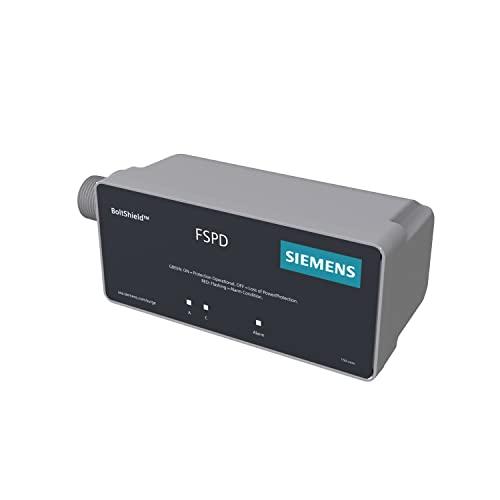
| Siemens Boltshield FSPD140 (140kA) | A Siemens panel, or a house that takes real lightning | 140,000A listed rating · 120/240V · Siemens Boltshield series · Fits Siemens load centers | $246.22·Amazon |
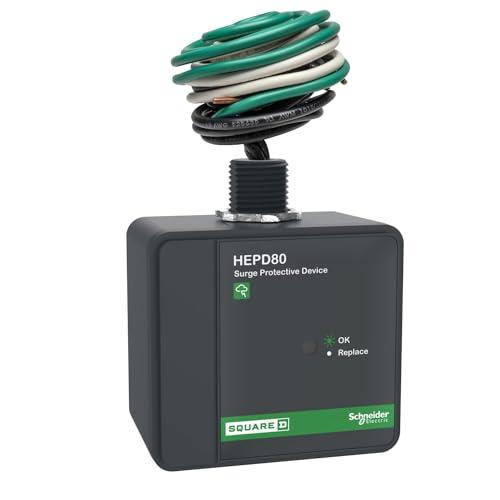
| Square D HEPD80 (80kA) | A Square D or Homeline load center | 80,000A listed rating · 1-phase, 3-wire · 120/240V · Square D HEPD series | $118.99·Amazon |
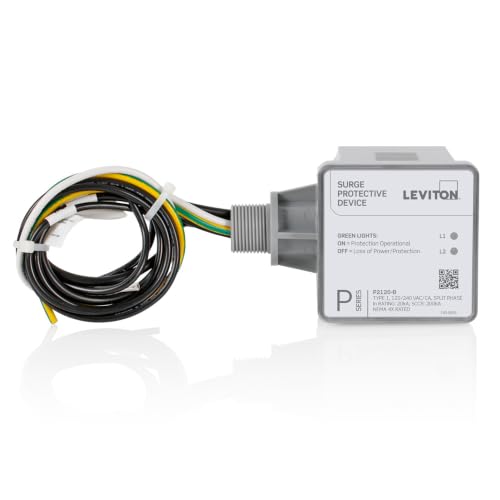
| Leviton P2120-B Type 1 Surge Panel | A Type 1 install ahead of the service disconnect | Type 1 SPD · 50,000A per phase · 120/240V split phase · Leviton P2120-B | Check price·Amazon |
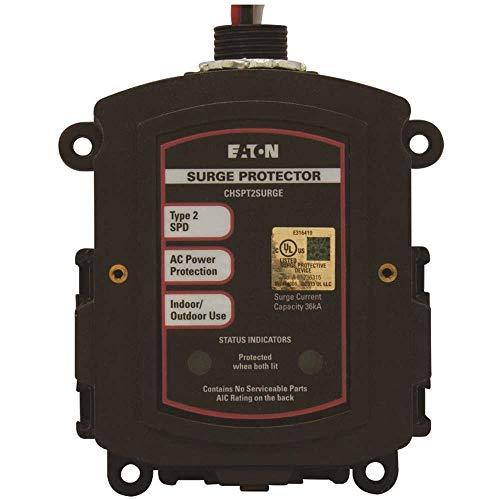
| Eaton CHSPT2SURGE (Type 2, NEMA 4) | Meeting the code requirement for the least money | Type 2 SPD · NEMA 4 enclosure · 120/240V single phase · UL 1449 3rd edition | $61.65·Amazon |
#ad · Prices read live from the Amazon Product API as of November 24, 2026, and they move. Specs are the manufacturer's published claims from the live listing — we have not bench-measured them. Where we have no verified price we print none rather than a number that has gone stale. We may earn a commission.
How we ranked them
Four criteria, in this order.
- Classification and listing first. A device has to be a Type 1 or Type 2 SPD with a UL 1449 listing to satisfy NEC 230.67. Anything that is not is not in this list, however good the marketing is.
- Panel-brand fit second. This is the criterion buyers underweight and electricians care about most. An SPD from the company that made your load center mounts the way the panel expects, pairs with the right breaker and does not need creative bracketry. Matching the brand is usually also the cheapest install.
- Listed surge current rating third. Higher is better, but the gap between 80,000 and 140,000 amps matters far less than the gap between having a device and not having one. We weight it third because geography decides how much it is worth: a long overhead rural feeder in a lightning belt is a different risk from an underground suburban service.
- Live price last. As everywhere on this site, read from the feed rather than typed in, and it moves the ranking only between devices that are otherwise close.
We have not tested any of these devices. We cannot — testing an SPD means destroying it with a surge generator, which is a laboratory exercise, and our research method says plainly that our scores come from published specifications, safety listings and arithmetic rather than a bench.
Which one for your panel
Eaton CH or BR panel. The CHSPT2ULTRA, or the CHSPT2SURGE if you want the same compliance for less money. Eaton panels are extremely common in US houses and both devices are designed for them.
Square D QO or Homeline. The HEPD80. Its listed rating is the lowest of the three big-brand devices here, but it is the device those panels are specified around, and on a part nobody will ever look at again that counts for more than 28,000 amps of headroom.
Siemens.The Boltshield FSPD140, which is also the highest-rated device on this page. One vocabulary warning: its listing calls it a “Level 2” device, which is Siemens' internal product tier and has nothing to do with Level 2 EV charging. On this site “Level 2” always means the 240-volt charging level; on that box it means a mid-tier SPD.
A service layout that needs line-side protection.The Leviton P2120-B, which is listed as a Type 1 device — the class permitted ahead of the service disconnect. This is a decision your electrician makes about your service, not a feature to go shopping for. If nobody has told you that you need Type 1, you do not need Type 1.
What a panel SPD does not do
Three honest limits, because this category attracts more confident marketing than it deserves.
It is not a substitute for correct wiring or the right breaker. A surge device does nothing about an undersized conductor, a loose lug or a breaker that is the wrong size for the charger. That work is the install, and wire size and breaker sizing is where to start.
It does not replace the GFCI protection the code requires. Surge protection and ground-fault protection solve unrelated problems. See whether you need a GFCI breaker for EV charging.
It wears out silently. An SPD absorbs energy over its life and eventually stops protecting. Every device here has an indicator; nobody looks at it. Put a note in your phone to glance at the status light once a year, at the same time you check the charger cable for damage.
Is it worth it on a charger project?
Yes, and the arithmetic is not close. A whole-panel SPD costs well under a tenth of a typical Level 2 charger installation and it is fitted during work that is already happening. Against that it protects the charger, the heat pump, the furnace control board, the range and every screen in the house. Even setting the code requirement aside, it is the cheapest line on the quote that defends the most equipment — which is the opposite of how most charger accessories look. Our accessories under $25 roundup covers the small parts; this is the one that is worth spending real money on.
What the specifications on the box mean
Type 1 versus Type 2.Type 1 devices are listed for installation on the line side of the service disconnect — before the main breaker. Type 2 devices go on the load side, at or immediately adjacent to the panel. NEC 230.67 accepts either. The vast majority of residential installs are Type 2, and if your electrician has not raised Type 1, the question does not apply to you.
Surge current rating (kA).The listed maximum the device is rated to divert, quoted either as a single figure or per phase. Per-phase numbers are not directly comparable to single figures, which is why we print each device's rating as the manufacturer states it rather than normalizing them into a leaderboard.
UL 1449.The standard for surge protective devices. The 3rd edition is the revision current residential devices are listed to, and “UL 1449 3rd edition” on a listing is the claim worth looking for.
Enclosure rating. Matters if the device mounts outdoors, which is common where the meter-main is on an exterior wall. The CHSPT2SURGE publishes NEMA 4; most indoor-panel devices publish nothing, because they are not meant to be out in weather. Our outdoor charger setup page covers the rest of that install.
Connected-equipment warranties. Every brand offers one. Treat them as a tiebreaker at most: claiming requires proof of a surge event, proof of correct installation and patience, and nobody should choose a device on the dollar figure printed next to that promise.