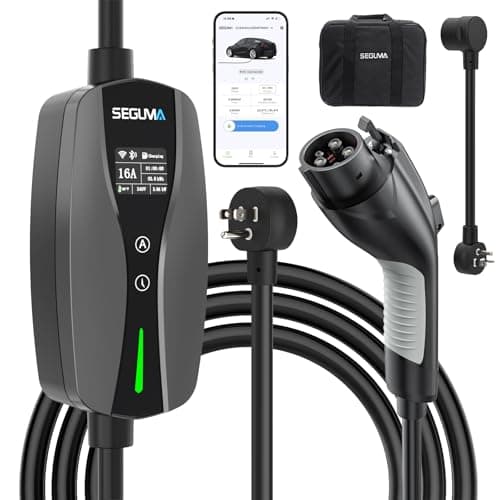
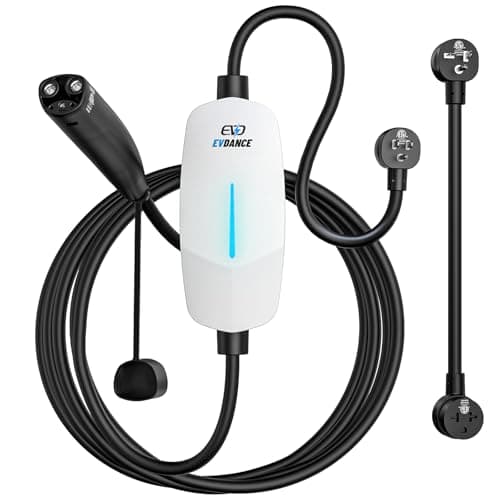
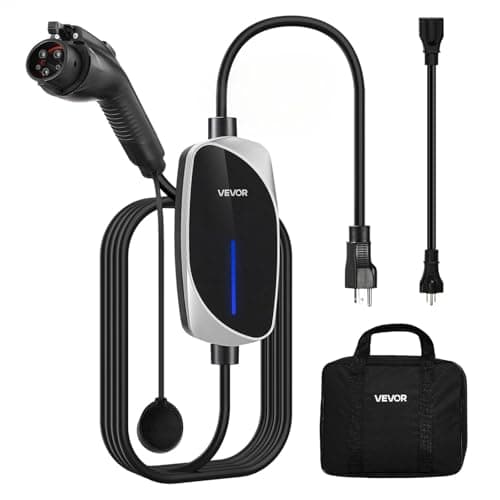
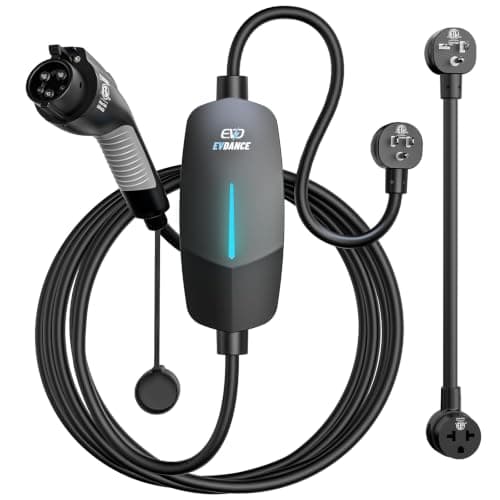
The best 16-amp EV charger is the EVDANCE Level 1&2 (12A/16A), and it is for the driver who wants one cord that works on the garage wall socket tonight and on a 240-volt outlet at a relative's house next month: it runs 12 amps at 120 volts and 16 amps at 240 volts, carries an ETL listing, and comes with 25 feet of cable plus the 6-20 adapter that makes the 240-volt half usable. The budget pick is the VEVOR Level 1&2 (16A, 25 ft), the cheapest cord here that still reaches 16 amps. If your car has a Tesla-style port, buy the EVDANCE NACS Mobile Connector rather than stacking an adapter on a J1772 cord, and if you want the charge to start at 2am on its own, the SEGUMA Wi-Fi Level 1/2 is the only cord here with Wi-Fi.
Every price on this page is read from the live Amazon feed and stamped with its own date, so the ranking reflects what things cost today rather than what they cost when this page was written. We compile published manufacturer specs and safety listings, read the live listing, and do the circuit arithmetic; we have not bench-tested these units and we do not claim to have. Our research method sets out exactly what our scores are and are not. Where a maker does not publish a figure, we say so instead of filling it in. We may earn a commission.
Why 16 amps is its own category
The amperage ladder for home charging runs 12, 16, 32, 40, 48 and 80 amps, and the rungs are not evenly spaced in usefulness. Twelve amps at 120 volts is the emergency cord that came in the boot: about 1.4 kW, three to five miles of range an hour. Thirty-two amps and up means a 240-volt circuit, a dedicated breaker and an electrician.
Sixteen amps sits exactly on the boundary. At 120 volts it is close to the most a standard household circuit can deliver continuously, and at 240 volts it is 3.84 kW — roughly 12 miles of range an hour, or about 100 miles across an eight-hour night. That is more than most American drivers cover in a day, from an outlet that may already exist. A 16-amp dual-voltage cord is the only hardware that can honestly be described as “plug it in almost anywhere and it works”.
The field, with live prices
| 16-amp cord | Best for | Key specs (manufacturer) | Price |
|---|
| VEVOR Level 1&2 (16A, 25ft) | The lowest price on a dual-voltage cord | 16A · 120V or 240V · J1772 · NEMA 6-20P + 5-15 adapter · 25ft cable | Check price·Amazon |
| EVDANCE Level 1&2 (12A/16A) | Most people buying a 110V charger | 12A @ 120V / 16A @ 240V · J1772 · NEMA 5-15 + 6-20 · ETL listed · 25ft | $101.99·Amazon |
| EVDANCE NACS Mobile Connector (12A/16A) | Tesla and other NACS cars | 12A @ 120V / 16A @ 240V · NACS (J3400) · NEMA 5-15 + 6-20 · 25ft cable | $127.45·Amazon |
| SEGUMA Wi-Fi Level 1/2 (12A/16A) | A 120V backup that is not dumb | 12A @ 120V / 16A @ 240V · J1772 · NEMA 5-15 + 6-20 adapter · ETL certified · 25ft | $129.99·Amazon |
#ad · Prices read live from the Amazon Product API as of November 24, 2026, and they move. Specs are the manufacturer's published claims from the live listing — we have not bench-measured them. Where we have no verified price we print none rather than a number that has gone stale. We may earn a commission.
What 16 amps actually adds overnight
Take the honest version of the maths rather than the marketing one. At 120 volts and 12 amps a cord delivers about 1.44 kW before losses. At 240 volts and 16 amps it delivers 3.84 kW — 2.7 times as much. On a car that uses roughly 0.3 kWh per mile, that is about 4.8 miles of range per hour from a wall socket and about 12.8 from a 240-volt outlet. Over a ten-hour overnight window: roughly 48 miles against roughly 128.
Losses are real and not small at this end of the scale. Charging at 120 volts wastes a larger fraction of what the meter records than charging at 240 volts does, because the car's own electronics and thermal management draw a fixed overhead regardless of how slowly the pack is filling. That is the practical reason to use the 240-volt half of a dual-voltage cord whenever an outlet allows it: more of each kilowatt-hour you pay for ends up in the battery.
The 240-volt half is the part to check
Every cord on this page ships with a 120-volt plug and reaches 240 volts through an adapter or a second plug, and the detail that matters is which240-volt plug. A NEMA 6-20 is a 20-amp circuit, which allows 16 amps continuous — the number these cords are built around. A 14-50 is a 50-amp circuit, which allows 40, so a 16-amp cord on a 14-50 outlet leaves most of the circuit unused. If the only 240-volt outlet you have is a 14-50, a 40-amp cord is the better buy; see our NEMA 14-50 charger page.
Do not improvise the 240-volt side. A 6-20 outlet is a small job for an electrician and it is the right job. Running a 16-amp cord off a household extension lead or a travel adapter is how connectors melt; our page on extension cords explains why both the gauge and the length matter.
How we ranked them
On the published current at each voltage first, because that is the whole product: a cord that claims 16 amps but only reaches it with an adapter the seller does not include is not a 16-amp cord in practice. Then on the safety listing named on the listing — ETL and UL mean a laboratory tested the thing, while a bare “CE” mark on a US charging cord means very little. Then on cable length, because 25 feet reaches a car parked the wrong way round and 16 feet often does not. Then on whether the connector matches your car without an adapter, and finally on live price.