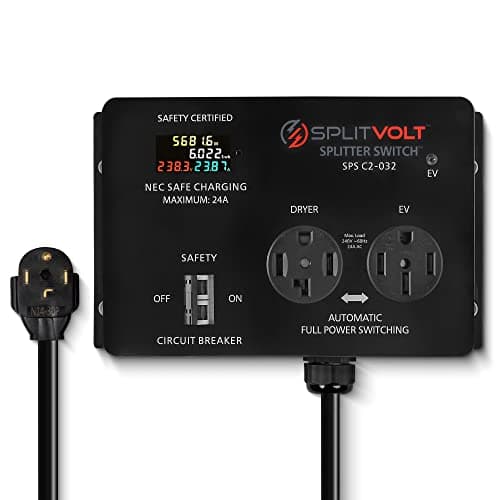
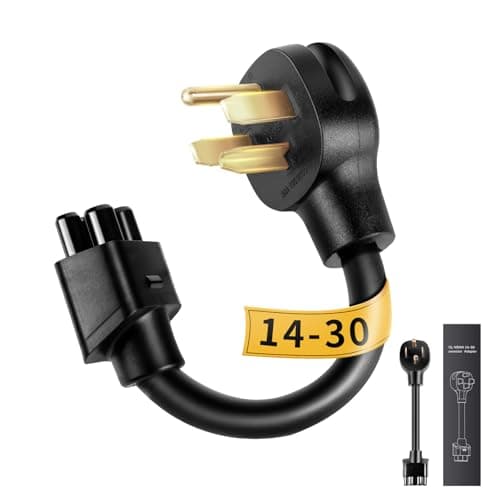
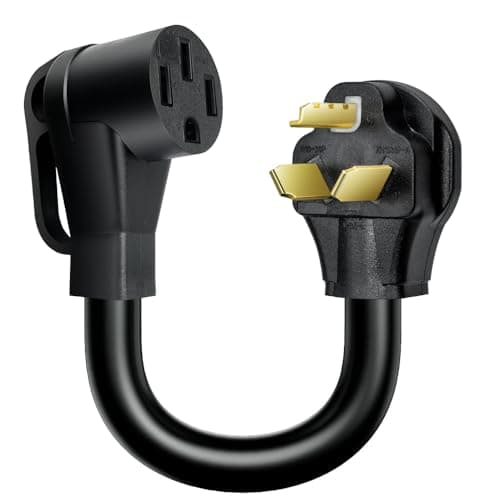
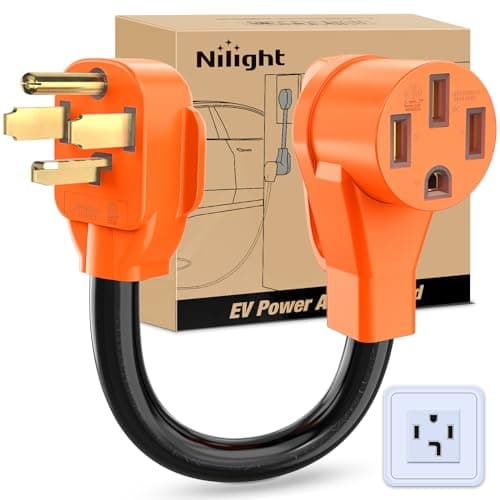
The best EV charger adapter for a dryer outlet is the Nilight NEMA 14-30P to 14-50R adapter, and it is for the owner of a modern four-prong dryer outlet who wants the one detail that matters published: it is built from four 10 AWG copper conductors in an STW jacket, and the listing states plainly that the charger must be set to 24 amps. The budget pick is the MECMO 14-30P adapter — the cheapest way to make the connection, with the same 24-amp ceiling stated up front, though it does not publish a wire gauge. If the dryer still needs its socket, the Splitvolt Splitter Switch is the only item here that lets both appliances share the circuit safely, and if you are plugging a Tesla Gen 2 Mobile Connector straight in, the WenStorm 14-30 Tesla adapter skips the 14-50 step entirely.
Every price on this page is read from the live Amazon feed and stamped with its own date, so the ranking reflects what things cost today rather than what they cost when this page was written. We compile published manufacturer specs and safety listings, read the live listing, and do the circuit arithmetic; we have not bench-tested these units and we do not claim to have. Our research method sets out exactly what our scores are and are not. Where a maker does not publish a figure, we say so instead of filling it in. We may earn a commission.
The one number: 24 amps
A dryer outlet — NEMA 14-30 on anything built in the last forty years, NEMA 10-30 on older installations — sits on a 30-amp circuit. The National Electrical Code treats EV charging as a continuous load, so a charger may draw no more than 80 percent of the circuit rating. Eighty percent of 30 is 24. Every adapter on this page is a 24-amp solution, and the charger plugged into it must be set to 24 amps or less before you use it.
This is not a formality. The adapters here end in a 14-50 receptacle, which is the socket a 40-amp charger expects, and a 40-amp charger will happily try to pull 40 amps through a 30-amp circuit if nobody tells it otherwise. The breaker is the last line of defence, not the plan. Set the charger down first — our page on setting the amps shows how it is done on the common units, and the adjustable-amperage roundup lists the chargers whose published range goes low enough to be a good match.
At 24 amps and 240 volts you get 5.76 kW, or roughly 18 miles of range an hour. Over a ten-hour overnight window that is around 180 miles — four to five times what a household wall socket delivers, from a circuit you already own.
The field, with live prices
| Dryer-outlet solution | Best for | Key specs (from the listing) | Price |
|---|
| MECMO NEMA 14-30P → 14-50R Adapter | Buyers who want the limit stated up front | 14-30P → 14-50R · Max 24A · 240V · 4-prong dryer only · Gauge not published | $15.99·Amazon |
| Nilight NEMA 14-30P → 14-50R Adapter | A four-prong (14-30) dryer outlet | 14-30P → 14-50R · 4 × 10 AWG copper · 12 in · STW jacket · Set charger to 24A | $22.49·Amazon |
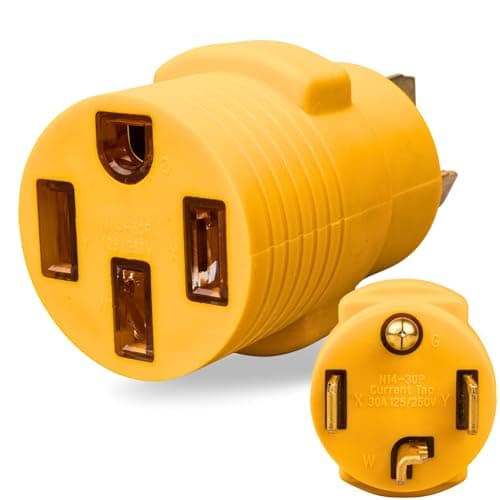
| air2yun NEMA 10-30P → 14-50R Adapter | An old three-prong 10-30 outlet, with caveats | 10-30P → 14-50R · ETL Listed (per listing) · No separate ground · Set charger to 24A | $19.19·Amazon |
| WenStorm NEMA 14-30 Tesla Adapter | A Tesla Gen 2 Mobile Connector on a dryer circuit | 14-30 → Tesla Gen 2 MC · 24A · 240V · ETL listed (claimed) · Nickel-plated pins | $46.59·Amazon |
| Splitvolt Splitter Switch (14-30/14-50) | A full panel with a dryer outlet in it | Shares a 30A dryer circuit · 24A max for charging · 14-30 in · dryer + EV out · cETLus certified | $312.00·Amazon |
#ad · Prices read live from the Amazon Product API as of November 24, 2026, and they move. Specs are the manufacturer's published claims from the live listing — we have not bench-measured them. Where we have no verified price we print none rather than a number that has gone stale. We may earn a commission.
Which dryer outlet do you have?
Count the slots. Four slots is a NEMA 14-30: two hots, a neutral and a separate ground, which is what current code requires and what the Nilight, MECMO and WenStorm adapters here are for. Three slots is a NEMA 10-30, an older configuration with no separate equipment ground — the neutral does both jobs. The air2yun adapter covers that case, and it is the one to think about carefully: charging on a 10-30 is legal where the existing circuit is grandfathered, but it gives up a safety layer that a four-prong circuit has. If an electrician is already coming, replacing a 10-30 with a modern outlet is money well spent.
There is also the question of what else is on the circuit. A dryer outlet is a dedicated 30-amp circuit, which is exactly what makes it usable — but it has a dryer on the end of it. Running both at once is not an option: the circuit cannot carry a dryer and 24 amps of charging together. You either unplug one to use the other, or you fit the Splitvolt switch, which interlocks the two so only one can draw at a time.
What a dryer-outlet setup does not do
It does not give you 40 amps, and no adapter can change that. It does not make an extension cord acceptable — these adapters are a foot long for a reason, and the right answer to “the dryer outlet is in the laundry room, the car is on the drive” is a longer charger cable or a new circuit, not a chain of adapters. And it does not survive being left permanently plugged in outdoors; a 14-30 adapter is a plug-and-socket joint exposed to whatever the laundry room or garage throws at it, so check it for heat and discolouration every few months.
How we ranked them
On whether the listing publishes the two facts that decide safety: the current ceiling and the conductor gauge. An adapter that states “set your charger to 24A” and names 10 AWG copper has told you what you need; one that states neither is asking you to trust it. Then on the safety listing claimed, then on build details like pin plating and jacket type, then on live price. We have not load-tested these adapters and do not claim to have — the ranking is built from the published specification on the live listing plus the circuit arithmetic.